
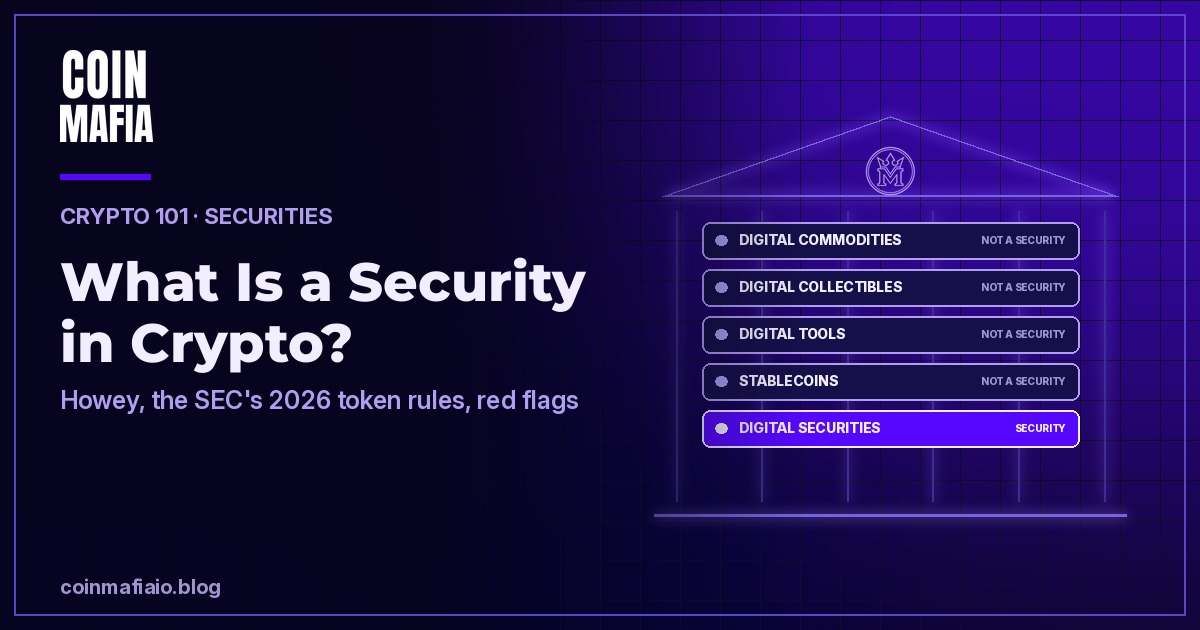
A security is a financial product, like a stock or a bond, or any deal where buyers put money into a shared venture and count on someone else’s work to make a profit. In the US, the Securities and Exchange Commission (SEC) decides which crypto deals fit that description using a 1946 Supreme Court case called Howey, and in March 2026 it published a five-part token taxonomy that says most crypto assets are not securities on their own (SEC). Congress has not yet passed a full crypto law: the CLARITY Act is stalled in the Senate (Congress.gov).
This guide is education only. It is not financial, legal or tax advice, and it does not tell you what to buy or sell.
What is a security?
The Securities Act of 1933 lists the kinds of things that count as securities: stocks, bonds, notes and a long list of similar financial products (15 U.S.C. 77b, Cornell LII). The idea is simple. When you hand money to a company or promoter and your result depends on what they do next, you deserve honest information first.
That is why securities come with rules. Sellers generally have to register the offering or qualify for an exemption, share material facts, and avoid lying or manipulating prices. The SEC enforces those rules at the federal level.
The Howey test, in plain English
The list in the law includes a catch-all term that courts have spent decades defining. In SEC v. W.J. Howey Co. (1946), the Supreme Court looked at a Florida company that sold strips of citrus grove to the public along with a service contract to farm the land and send buyers their share of the proceeds (Cornell LII). The Court said the deal was a security, and set out what is now called the Howey test.
The Howey test’s four-part definition covers a contract where people put money into a common enterprise expecting profits from others’ efforts (Cornell LII). Broken into questions:

- Money in. Did people pay money or something of value?
- Common enterprise. Is everyone’s money tied to the same venture, so they rise or fall together?
- Expecting profits. Did people buy hoping it would grow in value, not just to use it?
- From the efforts of others. Do those profits depend on a promoter or team doing the work?
The Court also said the form of the deal does not matter: what counts is the economic reality (Cornell LII). That is why a token can be pulled under securities law even if nobody calls it a share.
How the SEC applies Howey to crypto tokens in 2026
On March 17, 2026, the SEC issued an interpretation of how federal securities laws apply to crypto assets, and the Commodity Futures Trading Commission (CFTC) joined it (SEC press release 2026-30). SEC Chairman Paul S. Atkins said it acknowledges “that most crypto assets are not themselves securities.” A law firm alert from Cahill notes it replaces the SEC staff’s 2019 framework for crypto (Cahill).
The five token categories

According to the SEC’s fact sheet (Release 33-11412):
- Digital commodities (not securities): tokens whose value comes from a working (“functional”) crypto network and supply and demand, rather than from a team’s managerial efforts.
- Digital collectibles (not securities): tokens made to be collected or used, such as art, music, in-game items, characters or memes.
- Digital tools (not securities): tokens that do a practical job, like a membership, ticket, credential, title record or identity badge.
- Stablecoins (not securities): payment stablecoins issued by a permitted issuer under the GENIUS Act.
- Digital securities (securities): stocks, bonds and other securities that simply live on a blockchain, also called tokenized securities.
Cahill’s summary says the release names 16 crypto assets as digital commodities, including BTC, ETH, SOL and XRP (Cahill).
The catch: the deal can still be a security
The SEC also explained that a token that is not a security can still be sold as part of a deal that is one. That happens when the seller asks people for money with promises of essential managerial work that buyers would reasonably expect to produce profits. The SEC says that arrangement can end when the seller either delivers on those promises or fails to (SEC fact sheet).
In practice, the label on the token matters less than the promises around it. A roadmap, a “we will list on major exchanges” pitch or a profit-sharing promise all change the picture. The release also says protocol mining, protocol staking and wrapping a non-security token do not involve the offer and sale of a security, and that certain airdrops do not involve the money-in part of Howey (SEC fact sheet).
The CLARITY Act: stalled in the Senate
The SEC’s interpretation is guidance, not a statute. Congress’s attempt at a full rulebook for crypto markets is H.R. 3633, the Digital Asset Market Clarity Act, known as the CLARITY Act (Congress.gov).

- July 17, 2025: passed the House, 294 to 134 (Congress.gov).
- June 1, 2026: reported by the Senate Banking Committee with a substitute amendment (Congress.gov).
- September 15, 2026: the Senate failed 49 to 50 to end debate on the motion to proceed, and Senator Tillis entered a motion to reconsider, which is the latest action on the bill (Congress.gov).
- November 16, 2026: the bill was not on the Senate’s next announced votes as the post-election session began (TokenPost).
Until Congress acts, the SEC’s interpretation and court decisions are what draw the lines. For today’s regulation headlines, see Crypto Market Today: November 17, 2026.
Red flags the securities laws were built to catch
Whether or not a token is a security, these are the behaviors that tend to end in enforcement cases. Knowing them is one of the best ways to protect yourself.

1. Insider trading
Insider trading means trading on important information the public does not have yet. In the first crypto insider trading case, the SEC said a former Coinbase product manager tipped his brother and a friend about upcoming listing announcements, and they bought tokens ahead of the news and sold after. Both brothers settled with the SEC, and in the related criminal case one was sentenced to 24 months in prison and the other to 10 months (SEC).
What to watch for: unusual buying right before a big announcement, or “alpha” groups that always seem to know about listings early.
2. Surprise minting and supply inflation
If someone can create new tokens at will, every existing holder’s share can shrink overnight. In one SEC case, the creator of a token called Pearl allegedly used a web of wallets to secretly mint about four million unauthorized tokens for himself, sold them, and the price fell nearly 65% (SEC LR-24980).
What to watch for: a mint function only one wallet controls, large unlocks nobody explained, or a total supply on the block explorer that does not match what the project says. Our guide on how to verify a crypto project walks through those checks, and what a rug pull is covers how supply tricks often end. If you hold a token, tracking it in a free tool like STASH makes it easier to notice when something about your holdings stops adding up.
3. Insiders selling to each other to fake activity
Wash trading means the same people trade back and forth so a token looks busy. In 2022 the SEC charged a company called Hydrogen and a self-described market maker it hired to create “the false appearance of robust market activity” with a trading bot, then sell the company’s tokens into that market for more than $2 million (SEC 2022-175). In 2024 the SEC charged three so-called market makers and nine individuals over wash trading, including trades in a token that was created at the direction of the FBI to catch exactly this. The SEC said the bots at times generated billions of dollars of fake trading volume a day (SEC 2024-166).
What to watch for: big volume with very few real holders, volume that dwarfs liquidity, or a chart that moves in perfect steps. Our Mafia Watch guide to wash trading and fake volume shows how to spot it.
4. Big promises, little paper trail
The whole point of Howey is that when people count on a team’s work to make money, they deserve real information. Be careful with projects that promise returns from their own work but will not say who they are, what they will build, or how the money is used. Many token launches fail for exactly these reasons.
How to use this as a crypto user
- Read the promises, not just the token. Ask what the team says it will do, and whether your result depends on them doing it.
- Check supply yourself. Look up total supply and who can mint on a block explorer before you trust a chart.
- Be skeptical of volume. Trading activity is easy to fake. Holders and liquidity are harder.
- Learn the words. Terms like “material nonpublic information” and “tokenized securities” come up often. CODEX, CoinMafia’s plain-English crypto glossary, explains terms like these, and our Crypto Made Simple guide covers the basics.
- Ask a professional. If you are launching a token or raising money, talk to a securities lawyer. This post is not legal advice.
Frequently asked questions
What is a security in simple terms?
A security is a financial product like a stock or bond, or any deal where people put money into a shared venture expecting profits from someone else’s work. That last part comes from the Supreme Court’s Howey case (Cornell LII), and the full legal list is in Section 2 of the Securities Act (15 U.S.C. 77b).
Is bitcoin a security?
Under the SEC’s March 17, 2026 interpretation, which the CFTC joined, bitcoin is treated as a digital commodity, not a security. A law firm summary of the release lists 16 crypto assets named as digital commodities, including BTC, ETH, SOL and XRP (SEC; Cahill).
Did the CLARITY Act pass?
Not yet. The House passed it 294 to 134 on July 17, 2025, but a Senate vote to begin debate failed 49 to 50 on September 15, 2026, and it was not on the Senate’s next announced votes as of November 16, 2026 (Congress.gov; TokenPost).
Is insider trading illegal in crypto?
Yes, when the asset is a security. In 2023 the SEC settled insider trading charges against a former exchange product manager and his brother over trades placed ahead of listing announcements, and both served prison time in the related criminal case (SEC).
Keep learning
- Mafia Watch: How to Spot Wash Trading and Fake Crypto Volume
- How to Verify a Crypto Project
- What Is a Rug Pull?
- Why Token Launches Fail
- Crypto Made Simple
- How to Get Started in Crypto Safely
Disclaimer: This post is for education only and is not financial, legal or tax advice. CoinMafia does not tell you what to buy or sell and does not predict prices. Laws and SEC guidance change; check the original sources and talk to a qualified professional about your situation. Stay Mafia.
Leave a Reply