
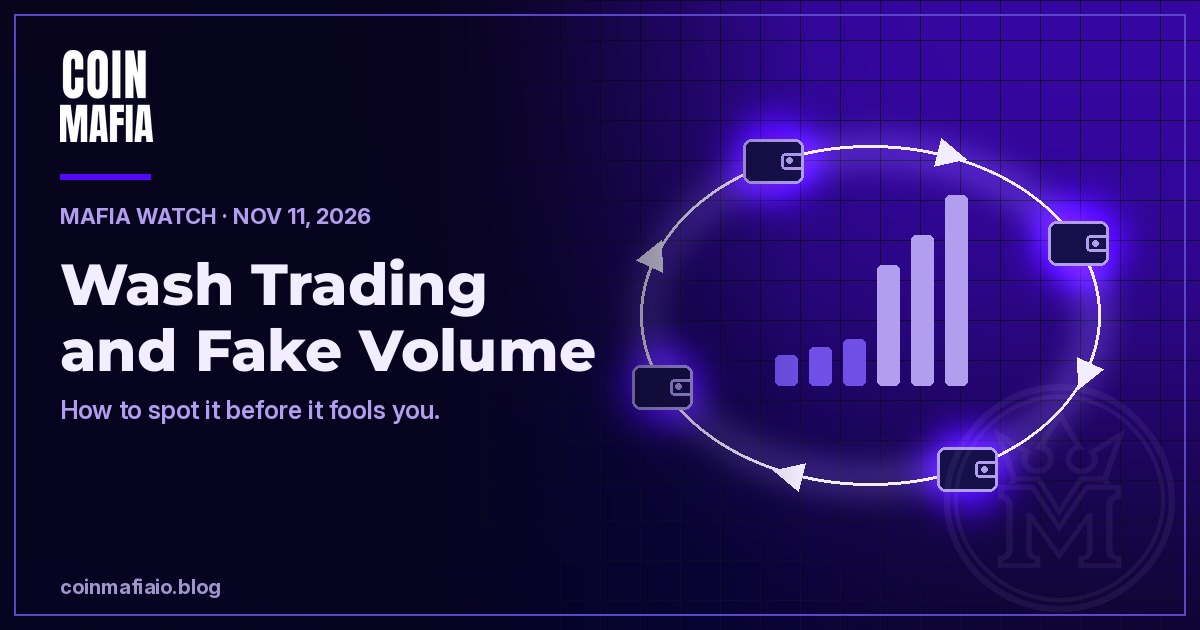
Wash trading is when the same person or group buys and sells a token to themselves to fake trading volume. The trades are real on-chain, but the coins never reach a new owner, so the volume number tells you nothing about real demand. You can spot it by checking whether a few wallets do most of the trading, whether trades go in circles, and whether the volume makes sense next to the token’s liquidity and holders.
Welcome to Mafia Watch, our weekly scam breakdown. This one is education, not financial advice, and we do not name or accuse any token here. We show you the pattern so you can check for yourself.
What is wash trading in crypto?
A wash trade is a trade with yourself. Chainalysis describes it as “the near-simultaneous buying and selling of an asset without any change in beneficial interest, ownership, or market position.” The goal is not profit on the trade. The goal is the number it leaves behind: volume.
Volume matters because people read it as proof of interest. Many sites rank tokens by 24-hour volume, and a token that suddenly shows millions in trades looks busy, popular and safe to get into. Fake volume borrows that trust.
How does a wash-trading loop work?

- One wallet funds many. In one method Chainalysis tracked, a “controller” address sends starting funds to many fresh wallets through a multi-sender tool. In 2024, controller addresses it flagged managed 183 wallets on average, and one managed 22,832 (Chainalysis).
- The wallets trade in circles. They buy and sell the same token in the same pool, often in near-matching amounts, so each round trip adds to volume without anyone new owning the coins.
- Bots do the work. Chainalysis looked at one volume-boosting bot service whose site said a bot generating $100,000 in volume within 24 hours cost 0.212 ETH, and that the bot then bought and sold the token 100 times in rapid succession (Chainalysis).
Why fake volume misleads buyers
Fake volume makes a token look liquid and in demand when it may be neither. Researchers Lin William Cong, Xi Li, Ke Tang and Yang Yang studied 29 crypto exchanges and estimated that wash trading averaged over 70% of reported volume on the unregulated exchanges they examined. They found these fabricated volumes improved exchange rankings and temporarily distorted prices (NBER working paper; published in Management Science in 2023).
On-chain, wash trading often shows up as one step in a bigger play. In Chainalysis’s walk-through of a typical pump-and-dump, the person behind it may wash trade to inflate volume, hype the token, then sell into the buyers that the fake activity attracted, leaving them “holding the bag” (Chainalysis). That is why it pairs so well with the rug pull playbook.
How common is wash trading on-chain?
Chainalysis estimated suspected wash trading on Ethereum, BNB Smart Chain and Base at up to $2.57 billion in 2024 decentralized-exchange volume, an upper-bound figure that combines two detection methods (Chainalysis). As a share of all DEX volume it was small, but it was concentrated: each month roughly 1,000 to 1,800 pools showed the activity, about 0.2% to 0.3% of the roughly 500,000 active pools.
That concentration is the lesson. Fake volume tends to sit in specific small pools, which is exactly where newer buyers chasing the next busy-looking token tend to land.
Real cases: the October 2024 market-maker charges
On October 9, 2024, the SEC charged three companies it called “so-called market makers,” ZM Quant, Gotbit and CLS Global, along with several individuals. It alleged they offered “market-manipulation-as-a-service,” including wash trading, and that their bots at times generated “quadrillions of transactions and billions of dollars of artificial trading volume each day.” Federal prosecutors brought parallel criminal charges that also named a fourth firm, MyTrade, CoinDesk reported.
The FBI went as far as creating its own token to catch the alleged scheme in the act, and prosecutors said about $25 million had been secured, per CoinDesk. These are allegations from the charging documents; check the court record for how each case was resolved.
6 on-chain red flags of fake volume

- A few wallets do most of the trading. Scroll the trades list. If the same handful of addresses keeps showing up, the volume is not coming from a crowd.
- Round trips. A wallet buys, then sells almost the same amount minutes later, again and again. Chainalysis flagged buy-and-sell pairs within about 25 blocks with less than a 1% difference in value.
- Volume far out of line with liquidity or holders. Millions in daily trades against a thin pool and a small, flat holder count does not add up.
- Fresh wallets funded from one source. New wallets that got their first gas from the same address and then went straight to trading the same token.
- Sudden spikes with no news. Volume jumps out of nowhere, with no update, listing or announcement to explain it.
- Lots of trades, no new holders. Thousands of swaps while the number of holders barely moves.
Fair warning: arbitrage and MEV bots also trade fast and in both directions, which Chainalysis notes can look similar. That is why you look for several flags together, not one.
How to check a token’s volume yourself

- Open the token on a block explorer. Every chain has one, such as Etherscan for Ethereum. Type the address yourself rather than clicking links from DMs.
- Read the holders and the trades. Who holds most of the supply? Who is doing the buying and selling? The same few addresses on both lists is a warning.
- Compare volume, liquidity and holders. Big volume, thin liquidity and few holders together are the classic fake-volume shape.
- Look up the busiest wallets. Paste a busy trader’s public address into a read-only tracker such as CoinMafia’s free STASH to see what else that wallet holds. A tracker only needs a public address; see What Is a Crypto Portfolio Tracker?.
- Never connect or sign to “check.” Looking things up needs no wallet connection and no signature. Our guide on what to check before you connect your wallet explains why.
It happens on every chain
Chainalysis measured Ethereum, BNB Smart Chain and Base, but the trick itself is chain-agnostic. Wherever tokens trade in liquidity pools, someone can trade with themselves, and that includes smaller ecosystems such as PulseChain. On smaller chains, pools are often thinner, so a little fake volume can look like a lot. The checks above work the same everywhere. For a fuller project checklist, see How to Verify a Crypto Project Before You Buy Anything.
Where CoinMafia stands
Plainly: CoinMafia has never wash-traded $MAFIA and does not fake its volume. We would rather show a smaller, honest number than a big, fake one. You do not have to take our word for it. Run the same checks on $MAFIA that you would run on any other token. If you want the background on the coin and the business around it, read Why $MAFIA?.
Mafia safety tip: volume is not a reason to rush
Fake volume usually travels with pressure: “volume is exploding,” “get in before it trends,” a DM from a stranger with a chart. Slow down. Check who is trading before you trust what is trading. If someone needs you to act in the next hour, that is the red flag. More on impersonators and fake promos in our holiday crypto scams guide.
Frequently asked questions
What is wash trading in crypto?
Wash trading is buying and selling the same token back and forth, usually with bots or wallets controlled by the same person or group, so trading volume looks bigger than it is. Chainalysis describes wash trades as the near-simultaneous buying and selling of an asset “without any change in beneficial interest, ownership, or market position.”
Is wash trading illegal?
Rules differ by country, and Chainalysis notes the legal definitions vary between jurisdictions. In the US, the SEC and federal prosecutors brought fraud and market-manipulation charges in October 2024 against so-called market makers accused of wash trading crypto tokens. This is education, not legal advice.
How can I tell if a token’s volume is fake?
Check who is trading. If a few wallets make most of the trades, if the same wallets buy and then sell almost the same amount minutes later, or if daily volume is far bigger than the pool’s liquidity and the holder count barely moves, treat the volume number as unreliable.
Does CoinMafia wash trade $MAFIA?
No. CoinMafia has never wash-traded $MAFIA and does not fake its volume. You do not have to take our word for it: the same checks in this post work on any token, including ours.
Keep learning
- What Is a Rug Pull and How Do You Spot One Before It Happens
- Why Most Token Launches Fail Before Anyone Notices
- How to Get Started in Crypto Safely
- Crypto Made Simple
Disclaimer: This post is for education only and is not financial, investment, legal or tax advice. CoinMafia does not tell you what to buy or sell, does not predict prices, and does not accuse any specific token or person of wash trading here. Do your own research.
Stay Mafia.
Leave a Reply