
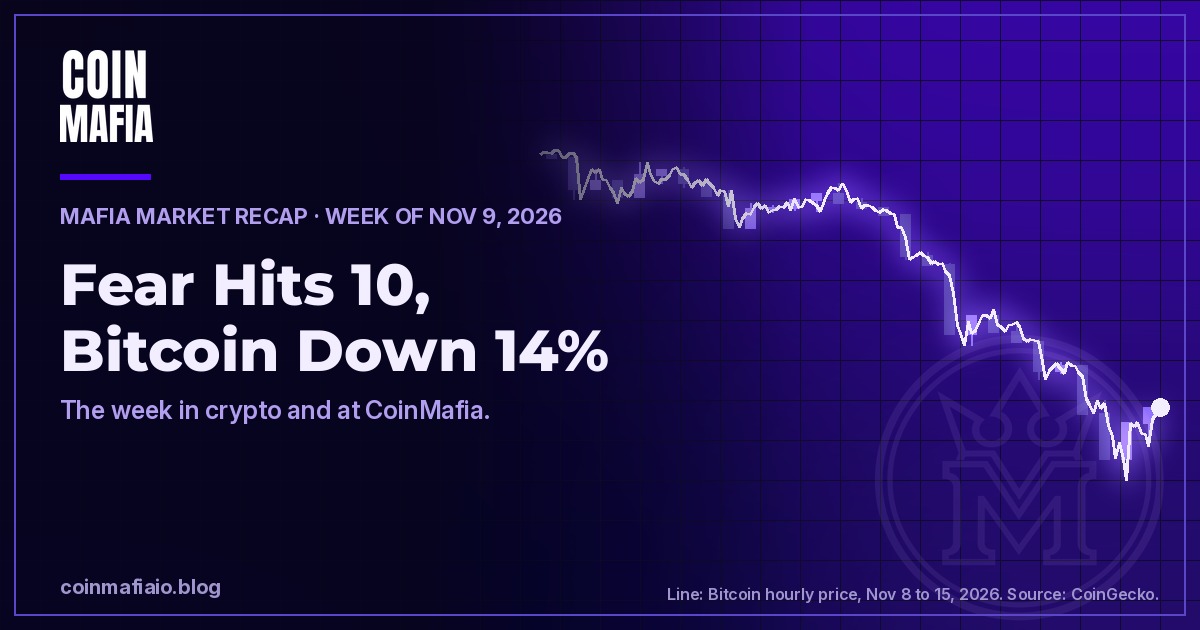
Crypto had a hard week. Bitcoin fell about 14% in seven days to near $65,500, Ethereum fell about 18% to near $1,830 (CoinGecko), and the Crypto Fear & Greed Index sank to 10, deep in Extreme Fear (alternative.me). The main drivers were hot US inflation data, a December Fed rate hike now treated as close to certain, steady ETF withdrawals and waves of forced selling from leveraged bets.
This is education, not financial advice. Prices were pulled around 6:00 a.m. ET on Sunday, November 15, 2026, and markets move fast, especially on thin weekend trading.
The week in 30 seconds
- Sentiment: Fear & Greed went from 29 on Monday to 10 on Sunday, its lowest reading of the week (alternative.me).
- Bitcoin: down about 13.6% over seven days to near $65,537 (CoinGecko), with a weekend low near $62,112 (Bloomberg via Business Standard).
- Ethereum: down about 18.1% to near $1,830 (CoinGecko), after touching $1,711, its lowest since July 8 (Bloomberg via Business Standard).
- The Fed: October CPI and PPI both ran hot, and markets now fully price a quarter-point hike at the December 8-9 meeting (CNBC).
- Forced selling: about $2 billion in leveraged positions were liquidated in the 24 hours into Sunday morning in Asia, mostly bets on higher prices (Bloomberg via Business Standard).
- At CoinMafia: our flagship PulseChain guide, The Mafia Standard, a Mafia Watch on fake volume, and a press release for STASH, our free portfolio tracker (PRLog).
Sentiment: from Fear to Extreme Fear

The Crypto Fear & Greed Index spent Monday through Thursday in Fear (29, 32, 29, 28), then dropped to 20 on Friday, 13 on Saturday and 10 this morning. The total crypto market is worth about $2.21 trillion, down about 5.3% in 24 hours, with Bitcoin making up about 59.5% of it (CoinGecko).
Keep perspective
A reading of 10 tells you how people feel, not what happens next. A few calm habits help in weeks like this:
- Zoom out. A one-week chart always looks louder than a one-year chart.
- Be patient. You never have to make a decision on a red Sunday. Your plan should not change because a gauge did.
- Protect your peace. Close the chart, mute the doom threads, and check back when you are rested.
- Watch for scams. Fear is when “recovery experts” and “guaranteed return” pitches get loudest. More on that below.
Bitcoin (BTC) this week: the slide sped up on the weekend

Bitcoin started the week near $75,810 and sits near $65,537 this morning, down about 13.6% over seven days on CoinGecko. Monday through Wednesday it held between about $73,000 and $75,000. Then it broke down:
- Thursday night: Bitcoin fell below $70,000 for the first time since August (CoinDesk).
- Saturday: it fell another 8% after US stocks closed Friday and touched just above $62,000 (CoinDesk). GSR co-founder Rich Rosenblum called it “a technical move” after bitcoin broke below its 200-day moving average near $73,000 (Bloomberg via Business Standard).
- Sunday in Asia: a low near $62,112, the weakest since July 14. Bitcoin is about 25% below its October 21 level, and its low for the year is $57,742 from July 1 (Bloomberg via Business Standard).
- ETF withdrawals: US spot bitcoin ETFs lost about $1.07 billion in the week of November 9-13, their seventh straight day of net outflows (crypto.news).
- A big holder loses an index spot: MSCI will remove Strategy, the largest listed bitcoin holder, from its global indexes after the November 30 close. That does not force Strategy to sell bitcoin (CoinDesk).
Ethereum (ETH) this week: hit harder than bitcoin
Ethereum fell from near $2,234 to near $1,830, about 18.1% over seven days (CoinGecko). It touched $1,711 on Sunday, its lowest since July 8, and about $488 million in ether positions were liquidated in the 24 hours into Sunday morning in Asia (Bloomberg via Business Standard).
- ETF flows: US spot ether ETFs lost about $399 million over the week, then took in a small $2.3 million on Friday (crypto.news; CryptoWatchDesk).
- Upgrade watch: outside audits of two proposed gas changes for the Glamsterdam upgrade were expected before November 16, with an open Q&A planned for the November 16 developer call (TokenPost; Ethlabs).
PulseChain (PLS) this week: steadier, but read the data with care
On PulseX, PulseChain’s largest exchange, wrapped PLS trades near $0.0000050 against USDC this morning, down about 1.2% over 24 hours, per DEX Screener. CoinGecko’s PLS feed had long gaps all week and showed almost no reported volume (CoinGecko), so we are not putting a precise weekly percentage on it. When trackers disagree, check more than one source, the same habit we teach in our Mafia Watch on fake volume.
Big week for our PulseChain coverage, too: we published What Is PulseChain? A Plain-English Guide, which explains the network, how it relates to Ethereum, and how to check it yourself.
What moved markets this week
Macro: inflation ran hot and the Fed is expected to hike
October consumer prices rose 0.4%, above the 0.3% expected (CNBC). Producer prices rose 0.3% for the month but were up 6.5% from a year earlier, the biggest annual gain since November 2022 (CNBC). Traders now see about an 89% chance of a quarter-point hike on December 9, the 10-year Treasury yield touched 5.17%, and the dollar hit its highest level since April 2025 (CNBC; Bitcoin Magazine).
Short term: higher yields and a stronger dollar tend to pull money away from riskier assets like crypto. Long term: how far the Fed raises rates into 2027 shapes how much appetite there is for risk across markets.
Tech: Nvidia’s CEO stepped down
Nvidia said Thursday that CEO Jensen Huang resigned, with CFO Colette Kress named interim CEO (CNBC). Chip stocks fell, and Bitcoin Magazine linked part of bitcoin’s Thursday drop to the AI-stock selloff (Bitcoin Magazine). Nvidia still plans to report earnings on Tuesday, November 17 (NPR).
Regulation: agencies move while Congress resets
The CLARITY Act is stalled, and with Democrats taking both chambers, a new market-structure bill looks more likely in 2027 (CNBC). Meanwhile the OCC gave Coinbase a full national trust charter (CoinDesk), and CFTC Chairman Michael Selig said major exchanges want to opt into the agency’s proposed crypto trading rules (CNBC). Short term: little changes for everyday users. Long term: who writes the rulebook, and how protective it is, is still being decided.
Dates to watch next week
- Mon, Nov 16: Ethereum developer call with a Q&A on the Glamsterdam audits (Ethlabs).
- Tue, Nov 17: Nvidia earnings (NPR).
- Nov 30: MSCI index change for Strategy takes effect after the close (CoinDesk).
- Dec 8-9: Federal Reserve meeting (CNBC).
This week at CoinMafia
- What Is PulseChain? A Plain-English Guide to the Ethereum-Compatible Network: our flagship explainer on the chain.
- The Mafia Standard: November 2026: our public list of what we will and will not do. No hype, no paid shills, no fake volume.
- What Is CoinMafia?: who we are, what we build, and what is live today.
- Mafia Watch: How to Spot Wash Trading and Fake Crypto Volume: the red flags behind fake activity.
- Why $MAFIA? and Crypto Made Simple: the coin, and crypto in plain English.
- What Is a Crypto Portfolio Tracker?: how read-only tracking works.
- STASH press release: “CoinMafia Opens Free Crypto Portfolio Tracker That Scans 62 Networks in the Browser” is live on PRLog. Try STASH with any public wallet address.
- Daily market posts every morning, Monday through Saturday. The latest: Crypto Market Today: November 14, 2026.
- Coming Tuesday: a plain-English explainer on what securities are and how the rules apply to crypto tokens.
Mafia safety tip: nobody can recover your losses for a fee
After weeks like this, “recovery” scammers go looking for people who lost money. The FBI warns they pose as law firms and even government agencies and ask for upfront fees (FBI IC3). The CFTC also warns about strangers adding you to WhatsApp or Telegram groups that promise “guaranteed” crypto returns (CFTC). Real law enforcement never charges you to get money back, and no real trade is guaranteed. Never share your seed phrase, and report scams at ic3.gov yourself.
Frequently asked questions
Why did crypto fall this week?
Hot US inflation data made a December Federal Reserve rate hike look close to certain, which lifted the dollar and bond yields (CNBC). US spot bitcoin ETFs saw about $1.07 billion in net outflows for the week (crypto.news), and falling prices forced the sale of about $2 billion in leveraged bets over 24 hours into Sunday (Bloomberg via Business Standard).
How much did Bitcoin drop this week?
About 13.6% over seven days, from near $75,810 on November 8 to near $65,537 on the morning of November 15, on CoinGecko hourly data. It touched about $62,112 in Asian trading on Sunday, its weakest level since July 14 (Bloomberg via Business Standard).
What is the Crypto Fear & Greed Index today?
It reads 10, “Extreme Fear,” on November 15, 2026, down from 32 on November 10, per alternative.me. It has been in Extreme Fear since November 13.
Is this financial advice?
No. CoinMafia shares market news for education only. We do not tell anyone what to buy or sell, and we do not predict prices.
Keep learning
- Crypto Market Today: November 14, 2026
- What Is PulseChain? A Plain-English Guide
- Mafia Watch: How to Spot Wash Trading and Fake Crypto Volume
- The Mafia Standard: November 2026
- How to Get Started in Crypto Safely
Disclaimer: This post is for education only and is not financial, legal or tax advice. CoinMafia does not tell you what to buy or sell and does not predict prices. Crypto is volatile; do your own research. Stay Mafia.
Leave a Reply