
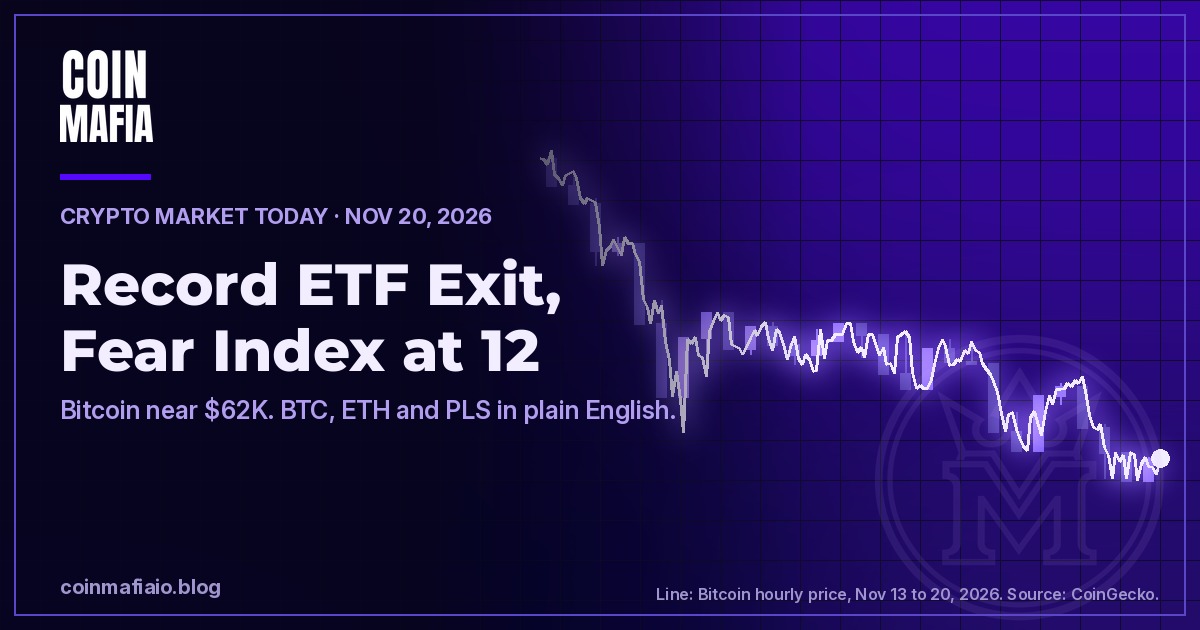
Crypto is still in Extreme Fear: the Fear & Greed Index reads 12 this morning, and Bitcoin is near $62,000 after falling to about $61,300 late Thursday, its lowest level since early July. BlackRock’s bitcoin ETF had its biggest one-day outflow on record, and rising real interest rates are pressuring bitcoin and gold alike (CoinDesk, Cointelegraph). Ethereum is near $1,755 (CoinGecko).
This is education, not financial advice. Prices below were pulled around 6:00 a.m. ET on Friday, November 20, 2026, and markets move fast.
Market sentiment: Extreme Fear at 12
The Crypto Fear & Greed Index reads 12 (Extreme Fear) this morning, two points higher than Thursday. Over the past eight days it has read 20, 13, 10, 10, 12, 11, 10 and 12, so the mood has stayed pinned near the bottom of the scale all week.

The total crypto market is worth about $2.14 trillion, down about 4.1% in 24 hours, with Bitcoin making up about 58.1% of it, according to CoinGecko’s global data.
Bitcoin: a four-month low near $61,300
Bitcoin is trading around $61,995, down about 2.8% in 24 hours (CoinGecko). Over seven days it has fallen from about $69,290 to $61,995, a drop of roughly 10.5%, with a low near $61,460 in CoinGecko’s hourly data.
Thursday started well. Bitcoin climbed back toward $64,000 in the morning as tech stocks rallied ahead of Anthropic’s stock market debut, then fell below $62,000 in the afternoon as the Nasdaq, S&P 500 and Dow all dropped about 2% (CoinDesk). Late Thursday it slid to nearly $61,300, and more than $600 million in crypto futures bets were liquidated over 24 hours, a sign that borrowed money was being forced out of the market (CoinDesk). CoinDesk also noted that bitcoin is on track for a seventh straight weekly loss, which would be its second-longest losing streak after nine weeks in 2022 (CoinDesk).
A record ETF exit. US spot bitcoin ETFs saw a net $582.3 million outflow on Thursday, November 19, the third straight day of withdrawals and about $1.13 billion over those three days. BlackRock’s IBIT alone lost $541.1 million (Farside), its largest single-day outflow since launching in January 2024, passing the $528.3 million record set on January 30, 2026 (Cointelegraph).

Ethereum: slipping toward $1,750
Ethereum is trading near $1,755, down about 2.6% over 24 hours and down about 10.0% over seven days, with a low near $1,725 in CoinGecko’s hourly data (CoinGecko). US spot Ether ETFs saw a net outflow of $131.2 million on Thursday, their fourth outflow day in a row, with BlackRock’s ETHA losing $124.2 million (Farside).
PulseChain (PLS): liquidity holding steady
CoinGecko’s PLS feed is again showing very little reported volume, so we use the most liquid on-chain market instead. On DEX Screener’s PulseX WPLS/USDC pair, PLS is around $0.0000047, down about 2.5% over 24 hours, with about $110,000 in 24-hour volume and about $601,000 in pool liquidity on that pair.
Total value locked on PulseChain apps is about $43.5 million, nearly unchanged from earlier this week, according to DefiLlama. In a market-wide sell-off, PLS is moving with everything else, and steady liquidity is the number worth watching on a quieter chain. New to the network? Start with our plain-English PulseChain guide.
What is moving markets
Rising real rates hit bitcoin and gold together
Gold fell nearly 3% to about $3,514 an ounce on Friday, its lowest since early September 2025, while bitcoin is down about 28% for the quarter. The common thread is “real rates,” bond yields after inflation: US two-year real rates have pushed above 2.4%, the highest since 2023, and longer-term real yields are at their highest in more than two decades (CoinDesk). Neither gold nor bitcoin pays interest, so they lose appeal when safe bonds pay more. Behind it all is a Federal Reserve leaning toward more rate hikes; JPMorgan now expects quarter-point increases in January and March on top of one in December (CoinDesk). The dollar near a 19-month high adds to the pressure (FXStreet).
Short term: as long as real yields and the dollar keep climbing, assets with no yield tend to struggle, and the Fed meeting on December 8-9 is the next big date. Long term: rate cycles do not last forever, and when borrowing costs eventually stop rising, that pressure eases. That is how rate cycles have worked in the past, not a forecast from us.
Anthropic’s debut, then a tech sell-off
Anthropic began trading on the Nasdaq on Thursday under the ticker ANT. Shares priced at $83, opened at $111.50 and closed the day at $97.17, after raising about $81.3 billion in the public offering (CoinDesk). The wider market did not follow: the Nasdaq fell 2.4% on Thursday and Nasdaq futures dipped below their 200-day average overnight (CoinDesk).
Short term: crypto has been trading in step with tech stocks on rough days, so tech weakness tends to spill over. Long term: Anthropic is not a crypto company, and one IPO says more about appetite for AI than about blockchain.
MoonPay applies for a US trust bank charter
On the regulation front, crypto payments firm MoonPay has applied to the Office of the Comptroller of the Currency for a national trust bank charter. The proposed MoonPay National Trust Bank, based in Miami Beach, would offer digital asset custody and stablecoin issuance and redemption but would not take deposits or make loans (Cointelegraph). The OCC lists it as received on November 18, one of a growing list of pending crypto-related bank applications (OCC). The GENIUS Act, which sets federal rules for stablecoin issuers, takes effect January 18, 2027 (Cointelegraph).
Short term: an application is not an approval, and nothing changes for users today. Long term: more crypto firms seeking federal oversight points toward clearer rules for custody and stablecoins, which tends to make the space safer for everyday people.
Keep perspective
A seventh week of falling prices and a fear reading stuck near the bottom of the scale can wear anyone down. A few calm reminders:
- Zoom out. A one-week chart is a tiny slice of the story. Look at the bigger picture before you make any decision.
- Patience is a plan. You do not have to do anything today. Choices made in a panic are the ones people most often regret.
- Protect your peace. It is fine to close the app, mute the doom threads and come back later. If checking several apps is what keeps pulling you back in, one read-only tracker like CoinMafia’s free STASH shows your whole picture at a glance with just your public address, never your keys.
- Scams rise in fear. Scammers know people are stressed and looking for answers, so be extra careful with messages and links you did not ask for.
Mafia safety tip: liquidations bring fake recovery offers
After a big wave of liquidations, scammers go looking for people who lost money. Watch for DMs, replies or “support agents” offering to recover liquidated funds, refund losses or reverse a trade for an upfront fee or your wallet’s secret phrase. Real exchanges do not reach out first to offer refunds, and no one can reverse a liquidation for a fee. If you were liquidated, contact your exchange only through its official app or website. For more on how these pitches work, read our Mafia Watch on the FaceStealer fake video call scam and what to check before you connect your wallet to anything.
Frequently asked questions
What is the Crypto Fear & Greed Index today?
It reads 12, “Extreme Fear,” on November 20, 2026, up two points from 10 on Thursday and down from 20 a week ago, per alternative.me.
Why did Bitcoin hit a four-month low?
Bitcoin fell to nearly $61,300 late Thursday, its lowest level since early July, as US stocks sold off after Anthropic’s Nasdaq debut and more than $600 million in crypto futures bets were liquidated (CoinDesk). Rising inflation-adjusted bond yields and a stronger dollar are also weighing on assets that pay no income, like bitcoin and gold (CoinDesk).
How much left bitcoin ETFs this week?
US spot bitcoin ETFs saw net outflows of $239.9 million on November 17, $306.5 million on November 18 and $582.3 million on November 19, about $1.13 billion over three days. BlackRock’s IBIT lost $541.1 million on Thursday alone (Farside), its largest single-day outflow since it launched in January 2024 (Cointelegraph).
Is this financial advice?
No. CoinMafia shares market news for education only. This is not financial, legal or tax advice, we do not tell anyone what to buy or sell, and we do not predict prices.
Keep learning
- Crypto Market Today: November 19, 2026
- Crypto Market Today: November 18, 2026
- Mafia Watch: The FaceStealer Fake Video Call Scam and How to Spot It
- What Is PulseChain? A Plain-English Guide
- How to Get Started in Crypto Safely
- What Is CoinMafia?
Disclaimer: This post is for education only and is not financial, legal or tax advice. CoinMafia does not tell you what to buy or sell and does not predict prices. Crypto is volatile; do your own research. Stay Mafia.
Leave a Reply