Author: coinmafiaio

  • Crypto Market Today: November 11, 2026

    Crypto Market Today: November 11, 2026

    Crypto is still in “Fear” this morning after a hot US inflation report. The Crypto Fear & Greed Index slipped to 29 (alternative.me), Bitcoin is near $73,977 and Ethereum near $2,058 (CoinGecko), and markets now price a December Fed rate hike as very likely after October CPI beat forecasts (Investing.com). PulseChain (PLS) is down about 6% over seven days on CoinGecko data.

    This is education, not financial advice. All prices below were pulled around 6:00 a.m. ET on November 11, 2026, and markets move fast.

    Market sentiment: back down to 29

    The Crypto Fear & Greed Index reads 29 (Fear) today, down from 32 on Tuesday. Over the past eight days it has read 34, 50, 28, 25, 28, 29, 32 and 29, so the only break from Fear was a single Neutral reading of 50 on November 5.

    Gauge showing the Crypto Fear and Greed Index at 29, Fear, on Nov 11, 2026, with daily readings from Nov 4 to Nov 11: 34, 50, 28, 25, 28, 29, 32, 29. Source: alternative.me.
    Source: alternative.me Crypto Fear & Greed Index, pulled Nov 11, 2026.

    The total crypto market is worth about $2.45 trillion, with Bitcoin making up about 60.5% of it, according to CoinGecko’s global data.

    Bitcoin (BTC) today: near a three-month low

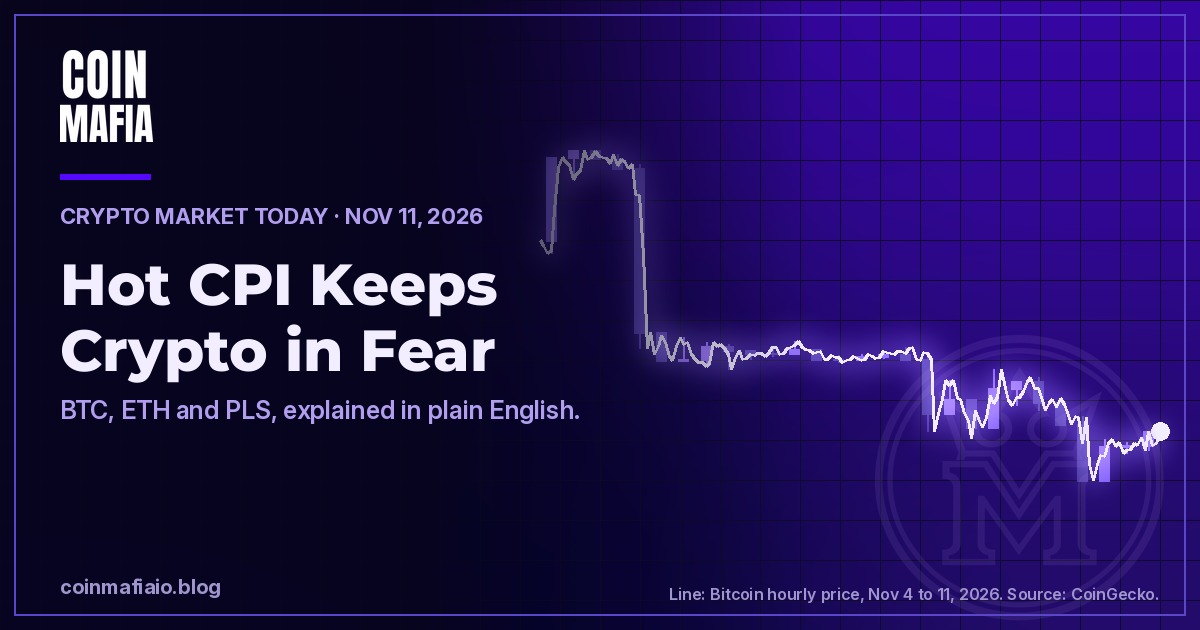
    Bitcoin is trading near $73,977, down about 0.2% over 24 hours and down 5.8% over seven days on CoinGecko. Hourly prices this week ranged from about $72,840 to about $80,670.

    • Three-month low overnight: Bitcoin hit a three-month low in overnight trade, pressured by a stronger dollar and higher yields, and was down 1.1% at $73,698 by 4:52 a.m. ET, Investing.com reported.
    • CPI-day dip: At Tuesday’s Wall Street open, bitcoin fell as low as $73,518, near Sunday’s low and its lowest level since August 21, before climbing back above $74,000, per Cointelegraph.
    • ETF outflows, day four: US spot bitcoin ETFs saw $95 million in net outflows on November 10, the fourth straight session. BlackRock’s IBIT lost $78.24 million and Fidelity’s FBTC $36.79 million, while Morgan Stanley’s MSBT took in $20.03 million, per TokenPost using SoSoValue data. Bitcoin.com News reported that 2026 net outflows now top $1.1 billion.
    Three line charts of hourly prices from Nov 4 to Nov 11, 2026: Bitcoin at $73,984, down 5.8%; Ethereum at $2,058, down 11.5%; PulseChain at $0.00000510, down 6.2%, with gaps in the PLS feed. Source: CoinGecko.
    Source: CoinGecko hourly prices, Nov 4 to Nov 11, 2026. Breaks in the PLS line are gaps in CoinGecko’s feed.

    Ethereum (ETH) today: down 11.5% on the week

    Ethereum is near $2,058, down about 1.5% over 24 hours and down 11.5% over seven days on CoinGecko, the weakest of the three coins we track here. The news around it:

    • Glamsterdam on hold for audits: The Ethereum Foundation asked core developers not to decide the next step for the Glamsterdam upgrade until outside audits of two proposed gas changes, EIP-8037 and EIP-8038, are public. The trigger was four reports of deployed contracts that could break under the changes, per the Ethereum Foundation blog and Crypto Briefing. The Hoodi testnet fork, once planned for October 26, had no new date as of November 10.
    • ETF flows: US spot ether ETFs also had a fourth straight day of outflows on November 10, though only about $1.3 million left, per Bitcoin.com News.

    PulseChain (PLS) today: down on the week, thin data

    PLS is near $0.0000051, down about 6.2% over seven days on CoinGecko and down about 5.8% over 24 hours on CoinMarketCap. Both trackers showed little or no reported 24-hour trading volume for PLS this morning, and CoinGecko’s hourly PLS feed had gaps this week, so read short-term moves with care.

    Quick refresher on the tech: CoinMarketCap describes PulseChain as an Ethereum fork that runs on proof-of-stake validators with roughly 3-second blocks and burns part of its transaction fees (CoinMarketCap). We did not find major-outlet PulseChain headlines this morning that we could verify, so we are sticking to the data. New to the chain? Start with What Is PulseChain and Why Was It Built and What Are PulseChain Validators.

    What is moving markets: inflation, the Fed, tech and Washington

    Macro: CPI came in hot

    The Bureau of Labor Statistics said consumer prices rose 0.4% in October, above the 0.3% economists expected, and core prices rose 0.3% versus 0.2% expected. Shelter accounted for over 30% of the monthly increase, and there was no yearly rate because last year’s shutdown stopped October 2025 data collection (CNBC). The Cleveland Fed estimated the yearly jump at 3.8%, well above the Fed’s 2% target (Yahoo Finance/AFP). Fed Governor Christopher Waller had said the Fed ought to raise rates in December and consider a half-point hike if inflation worsens (Reuters via Investing.com).

    Likely short-term impact: CME FedWatch showed close to an 89% chance of a quarter-point hike in December and a small chance of a half point, Investing.com reported, and higher rates tend to weigh on speculative assets. Longer term: how far the Fed goes on rates into 2027 shapes how much appetite there is for riskier assets like crypto.

    Tech: a shaky day for the Nasdaq

    The Nasdaq Composite opened down 0.6% on CPI day before recovering, and Nvidia shares fell nearly 4%, Cointelegraph reported. It also cited the prospect of tighter AI-sector regulation under a Democratic-controlled Congress as a headwind for stocks. Why it matters for crypto: bitcoin often trades alongside big tech on risk-off days, so tech weakness can spill over in the short term.

    Regulation: banks for crypto firms, and a cloudier Congress

    The OCC upgraded Coinbase’s national trust charter from conditional to full, letting it run federally regulated custody and payments services without taking deposits or making loans, CoinDesk reported. Ripple won the same status last month, while the Independent Community Bankers of America is suing the OCC over these charters. Separately, Investing.com said uncertainty over the US regulatory outlook is weighing on crypto after Democrats won majorities in both chambers of Congress. Short term: little changes for everyday users. Long term: more crypto firms inside the banking system, but slower progress on new market rules.

    Mafia safety tip: brand-new tokens with sudden action

    Not every busy-looking token is busy because people want it. Elliptic found North Korea’s TraderTraitor group moving stolen funds through freshly minted meme coins it created for about $90 apiece, washing roughly $430,000 through six of them on NEAR between November 5 and 7, Decrypt reported. Before you trust a volume number, check who is actually trading. This week’s Mafia Watch on wash trading and fake volume shows you how.

    Frequently asked questions

    Why is crypto down today, November 11, 2026?

    October US inflation came in hotter than expected, and traders now see a December Federal Reserve rate hike as very likely, which weighs on riskier assets like crypto, Investing.com reported. US spot bitcoin ETFs also posted a fourth straight day of net outflows on November 10, per TokenPost using SoSoValue data.

    What is the Crypto Fear & Greed Index today?

    It reads 29, “Fear,” on November 11, 2026, down from 32 the day before, per alternative.me. It has stayed in Fear or Extreme Fear every day this week except November 5, when it touched 50.

    What did the October CPI report show?

    Consumer prices rose 0.4% in October versus 0.3% expected, and core prices rose 0.3% versus 0.2% expected, CNBC reported. The Bureau of Labor Statistics did not publish a yearly rate because of last year’s government shutdown.

    Is this financial advice?

    No. CoinMafia shares market news for education only. We do not tell anyone what to buy or sell, and we do not predict prices.

    Keep learning

    Disclaimer: This post is for education only and is not financial, investment, legal or tax advice. CoinMafia does not tell you what to buy or sell and does not predict prices. Crypto is volatile; do your own research.
  • Mafia Watch: How to Spot Wash Trading and Fake Crypto Volume

    Mafia Watch: How to Spot Wash Trading and Fake Crypto Volume

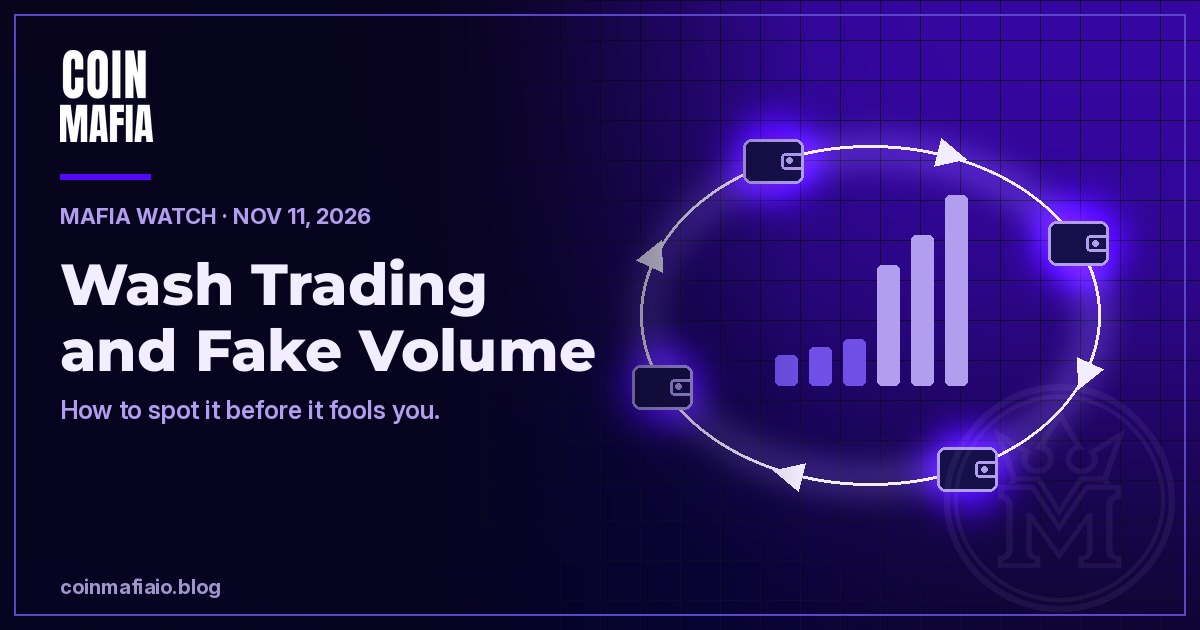
    Wash trading is when the same person or group buys and sells a token to themselves to fake trading volume. The trades are real on-chain, but the coins never reach a new owner, so the volume number tells you nothing about real demand. You can spot it by checking whether a few wallets do most of the trading, whether trades go in circles, and whether the volume makes sense next to the token’s liquidity and holders.

    Welcome to Mafia Watch, our weekly scam breakdown. This one is education, not financial advice, and we do not name or accuse any token here. We show you the pattern so you can check for yourself.

    What is wash trading in crypto?

    A wash trade is a trade with yourself. Chainalysis describes it as “the near-simultaneous buying and selling of an asset without any change in beneficial interest, ownership, or market position.” The goal is not profit on the trade. The goal is the number it leaves behind: volume.

    Volume matters because people read it as proof of interest. Many sites rank tokens by 24-hour volume, and a token that suddenly shows millions in trades looks busy, popular and safe to get into. Fake volume borrows that trust.

    How does a wash-trading loop work?

    CoinMafia diagram: one controller wallet funds wallets A, B and C, all with the same owner; they buy and sell back and forth in one token trading pool, so the volume counter climbs fast while real new buyers stay at none and ownership is unchanged.
    The basic loop. Pattern described by Chainalysis and in SEC charges from October 2024.
    • One wallet funds many. In one method Chainalysis tracked, a “controller” address sends starting funds to many fresh wallets through a multi-sender tool. In 2024, controller addresses it flagged managed 183 wallets on average, and one managed 22,832 (Chainalysis).
    • The wallets trade in circles. They buy and sell the same token in the same pool, often in near-matching amounts, so each round trip adds to volume without anyone new owning the coins.
    • Bots do the work. Chainalysis looked at one volume-boosting bot service whose site said a bot generating $100,000 in volume within 24 hours cost 0.212 ETH, and that the bot then bought and sold the token 100 times in rapid succession (Chainalysis).

    Why fake volume misleads buyers

    Fake volume makes a token look liquid and in demand when it may be neither. Researchers Lin William Cong, Xi Li, Ke Tang and Yang Yang studied 29 crypto exchanges and estimated that wash trading averaged over 70% of reported volume on the unregulated exchanges they examined. They found these fabricated volumes improved exchange rankings and temporarily distorted prices (NBER working paper; published in Management Science in 2023).

    On-chain, wash trading often shows up as one step in a bigger play. In Chainalysis’s walk-through of a typical pump-and-dump, the person behind it may wash trade to inflate volume, hype the token, then sell into the buyers that the fake activity attracted, leaving them “holding the bag” (Chainalysis). That is why it pairs so well with the rug pull playbook.

    How common is wash trading on-chain?

    Chainalysis estimated suspected wash trading on Ethereum, BNB Smart Chain and Base at up to $2.57 billion in 2024 decentralized-exchange volume, an upper-bound figure that combines two detection methods (Chainalysis). As a share of all DEX volume it was small, but it was concentrated: each month roughly 1,000 to 1,800 pools showed the activity, about 0.2% to 0.3% of the roughly 500,000 active pools.

    That concentration is the lesson. Fake volume tends to sit in specific small pools, which is exactly where newer buyers chasing the next busy-looking token tend to land.

    Real cases: the October 2024 market-maker charges

    On October 9, 2024, the SEC charged three companies it called “so-called market makers,” ZM Quant, Gotbit and CLS Global, along with several individuals. It alleged they offered “market-manipulation-as-a-service,” including wash trading, and that their bots at times generated “quadrillions of transactions and billions of dollars of artificial trading volume each day.” Federal prosecutors brought parallel criminal charges that also named a fourth firm, MyTrade, CoinDesk reported.

    The FBI went as far as creating its own token to catch the alleged scheme in the act, and prosecutors said about $25 million had been secured, per CoinDesk. These are allegations from the charging documents; check the court record for how each case was resolved.

    6 on-chain red flags of fake volume

    CoinMafia checklist of 6 red flags of fake trading volume: a few wallets do most of the trading; round trips; volume far bigger than the pool; fresh wallets funded from one source; spikes with no news; lots of trades but no new holders.
    Red flags drawn from the detection methods Chainalysis describes. One flag alone is not proof.
    • A few wallets do most of the trading. Scroll the trades list. If the same handful of addresses keeps showing up, the volume is not coming from a crowd.
    • Round trips. A wallet buys, then sells almost the same amount minutes later, again and again. Chainalysis flagged buy-and-sell pairs within about 25 blocks with less than a 1% difference in value.
    • Volume far out of line with liquidity or holders. Millions in daily trades against a thin pool and a small, flat holder count does not add up.
    • Fresh wallets funded from one source. New wallets that got their first gas from the same address and then went straight to trading the same token.
    • Sudden spikes with no news. Volume jumps out of nowhere, with no update, listing or announcement to explain it.
    • Lots of trades, no new holders. Thousands of swaps while the number of holders barely moves.

    Fair warning: arbitrage and MEV bots also trade fast and in both directions, which Chainalysis notes can look similar. That is why you look for several flags together, not one.

    How to check a token’s volume yourself

    CoinMafia 5-step guide to checking a token's volume: open it on a block explorer; look at holders and trades; compare volume, liquidity and holders; look up the busiest wallets in a read-only tracker such as STASH; never connect or sign to check.
    Five checks that need no wallet connection and no signature.
    • Open the token on a block explorer. Every chain has one, such as Etherscan for Ethereum. Type the address yourself rather than clicking links from DMs.
    • Read the holders and the trades. Who holds most of the supply? Who is doing the buying and selling? The same few addresses on both lists is a warning.
    • Compare volume, liquidity and holders. Big volume, thin liquidity and few holders together are the classic fake-volume shape.
    • Look up the busiest wallets. Paste a busy trader’s public address into a read-only tracker such as CoinMafia’s free STASH to see what else that wallet holds. A tracker only needs a public address; see What Is a Crypto Portfolio Tracker?.
    • Never connect or sign to “check.” Looking things up needs no wallet connection and no signature. Our guide on what to check before you connect your wallet explains why.

    It happens on every chain

    Chainalysis measured Ethereum, BNB Smart Chain and Base, but the trick itself is chain-agnostic. Wherever tokens trade in liquidity pools, someone can trade with themselves, and that includes smaller ecosystems such as PulseChain. On smaller chains, pools are often thinner, so a little fake volume can look like a lot. The checks above work the same everywhere. For a fuller project checklist, see How to Verify a Crypto Project Before You Buy Anything.

    Where CoinMafia stands

    Plainly: CoinMafia has never wash-traded $MAFIA and does not fake its volume. We would rather show a smaller, honest number than a big, fake one. You do not have to take our word for it. Run the same checks on $MAFIA that you would run on any other token. If you want the background on the coin and the business around it, read Why $MAFIA?.

    Mafia safety tip: volume is not a reason to rush

    Fake volume usually travels with pressure: “volume is exploding,” “get in before it trends,” a DM from a stranger with a chart. Slow down. Check who is trading before you trust what is trading. If someone needs you to act in the next hour, that is the red flag. More on impersonators and fake promos in our holiday crypto scams guide.

    Frequently asked questions

    What is wash trading in crypto?

    Wash trading is buying and selling the same token back and forth, usually with bots or wallets controlled by the same person or group, so trading volume looks bigger than it is. Chainalysis describes wash trades as the near-simultaneous buying and selling of an asset “without any change in beneficial interest, ownership, or market position.”

    Is wash trading illegal?

    Rules differ by country, and Chainalysis notes the legal definitions vary between jurisdictions. In the US, the SEC and federal prosecutors brought fraud and market-manipulation charges in October 2024 against so-called market makers accused of wash trading crypto tokens. This is education, not legal advice.

    How can I tell if a token’s volume is fake?

    Check who is trading. If a few wallets make most of the trades, if the same wallets buy and then sell almost the same amount minutes later, or if daily volume is far bigger than the pool’s liquidity and the holder count barely moves, treat the volume number as unreliable.

    Does CoinMafia wash trade $MAFIA?

    No. CoinMafia has never wash-traded $MAFIA and does not fake its volume. You do not have to take our word for it: the same checks in this post work on any token, including ours.

    Keep learning

    Disclaimer: This post is for education only and is not financial, investment, legal or tax advice. CoinMafia does not tell you what to buy or sell, does not predict prices, and does not accuse any specific token or person of wash trading here. Do your own research.

    Stay Mafia.

  • Why $MAFIA? The Coin, the Validators, and the Business Around Them

    Why $MAFIA? The Coin, the Validators, and the Business Around Them

    CoinMafia is the company. $MAFIA is the coin. If you have been asking “why $MAFIA,” the useful answer is not a price call. It is a description of how the company, its validator operation, and the coin are said to fit together. This post stays with what CoinMafia’s own materials and official PulseChain sources actually state. Where a mechanic is not clearly documented, it is left out.

    This is education, not financial advice. Nothing here is a recommendation to buy or sell $MAFIA, and nothing here is a promise of returns.

    What is $MAFIA?

    $MAFIA is the coin of the CoinMafia company. Company materials describe it as a bonding curve token on PulseChain, and as the first token on the company’s launchpad. A bonding curve, in the company’s own launchpad documentation, is the pricing method used so that a token’s price is set in a transparent way as the token is created and traded (coinmafia.io/docs). This post does not invent a supply figure, a curve formula, or a price path for $MAFIA, because those details are not set out in the materials reviewed for this explainer.

    The company’s approved line for this relationship is simple: “The coin was never the endgame. It was the beginning.” In other words, the coin is part of a wider business, not the whole of it.

    The company also says it has never wash-traded $MAFIA, and that the coin’s price and volume are organic. That is a company statement, not an independent audit, and it is not a claim about what the price will do next.

    What does a PulseChain validator do?

    $MAFIA lives on PulseChain, whose native currency is PLS. Official PulseChain materials describe PulseChain as a live mainnet, and they treat validators as the way operators help secure the chain (PulseChain mainnet documentation). The official PulseChain launchpad presents itself as a list of ways to register validators “to secure the chain” (launchpad.pulsechain.com). The official PulseChain mainnet documentation adds that running a validator is a responsibility: the operator has to keep the node healthy and running, or deposited funds are at risk. Those are general PulseChain facts. They are not unique to CoinMafia, and they are not a reason to buy any token.

    A validator is not the same thing as a coin in your wallet. A validator is an operator role on the chain. Holding $MAFIA does not, by itself, mean you are running one of CoinMafia’s validators.

    How CoinMafia’s 8,000 validators fit in

    CoinMafia currently operates 8,000 validators, and it says it will be accumulating more. The company describes this fleet as running on infrastructure it owns, including servers bought outright rather than rented. It also says it is entirely self-funded by its founders, with no crowdfunding, loans or outside funding, and that it is “building an honest company with our own funds, not at holders’ expense.” It has described a plan to “scale it into a full-fledged financial brand.” That last line is an ambition, not a claim that the brand is already finished.

    The company says it runs 4,000 validators that fund the business, and 4,000 dedicated to $MAFIA.

    On PulseChain, the company uses this trust line: “No sandwiching. No frontrunning. No reorgs. Ever.” Company materials present the validator operation as part of how that promise is meant to be kept. This post does not treat the line as a guarantee that nothing can go wrong.

    How those dedicated validators relate to $MAFIA

    Every month, the company says, the output of those 4,000 validators dedicated to $MAFIA goes to buy-and-burns of $MAFIA, adding liquidity, and/or paying the costs of running those 4,000 validators. There is no set schedule for which of those uses happens in a given month. This post does not promise an amount.

    Read that carefully. The company is describing a use of validators it operates. Holding $MAFIA is not the same as operating a validator, and this policy is not a promise that holders earn validator rewards. Buy-and-burns or added liquidity are also not a prediction that the price will rise.

    CoinMafia card explaining how the business, the validators and the coin fit: 8,000 validators in two groups of 4,000, with 4,000 funding the business and 4,000 dedicated to $MAFIA. Every month, output from the dedicated validators goes to buy-and-burns, added liquidity, and/or the costs of running those validators, with no set schedule for which use happens in a given month. Holding the coin is not running a validator.
    How the documented pieces fit, in plain English.

    The business built around the coin

    CoinMafia describes itself as a cryptocurrency company built for EVM networks, with seven crypto services on nodes and validators it owns. Three of those services are described as live, and four are in prelaunch, meaning they are not available yet.

    The live product that can be checked today is STASH, a free crypto portfolio tracker. The company describes it as a command center for balances, farms, exchange accounts and tax math, with no account, no paywall, and keys that never leave your browser. It carries no ads, no pay-to-rank or pay-to-list placements, and does not sell user data. Type the address yourself, or use a bookmark. For how a read-only tracker works, see What Is a Crypto Portfolio Tracker?.

    The company also describes two other live products in its materials: FORGE, a token launchpad open on Ethereum and PulseChain, which it says uses a bonding curve, permanent burns, and zero hidden allocations; and CODEX, a free, plain-English reference for blockchain, crypto, finance and fintech terms, with no account needed. Those product pages were not loading when this draft was prepared, so this post names them from company materials and does not link them.

    The four prelaunch services, which are not available yet, are BLOCK (validator hosting on hardware the company says it owns), DESK (a PulseChain exchange aggregator), RUNNER (a stablecoin bridge between Ethereum and PulseChain), and WIRE (a public RPC on nodes the company says it owns, plus a private route for CoinMafia trades). Do not treat any of those four as live tools.

    CoinMafia card on what is built around $MAFIA: live tools in the company's description, four services still in prelaunch, funding by its founders, and a reminder that this is education, not advice.
    The business around the coin, including what is not live yet.

    The company also publishes education at coinmafiaio.blog, including Crypto Made Simple. Official team links are collected at t.me/CoinMafiaOfficial.

    What this explanation does not mean

    A company with validators, a coin, and live software is still not a shortcut around basic safety. Wallets can be drained. Fake sites can look official. Buy-and-burns or added liquidity are not a promise of price, and a bonding curve is not a promise that a token is safe to buy. If you are new to the space, start with How to Get Started in Crypto Safely and Crypto Made Simple.

    Frequently asked questions

    Why $MAFIA, if CoinMafia is the company?

    Because the company and the coin are not the same thing. CoinMafia is the company. $MAFIA is the coin. Company materials present the coin as part of a wider business that also includes a validator operation and a set of crypto services.

    Does holding $MAFIA mean I earn validator rewards?

    No. Holding $MAFIA is not the same as operating a validator. The company says that every month, the output of 4,000 dedicated validators goes to buy-and-burns of $MAFIA, adding liquidity, and/or paying the costs of running those validators. That is a company policy. It is not a statement that holders earn validator rewards, and it is not a promise of returns or of a higher price.

    What chain is $MAFIA on?

    Company materials describe $MAFIA as a bonding curve token on PulseChain, and as the first token on the company’s launchpad.

    How many validators does CoinMafia run?

    The company currently says it operates 8,000 validators, and that it will be accumulating more. It says 4,000 of those validators fund the business, and 4,000 are dedicated to $MAFIA.

    How is the output of the 4,000 $MAFIA-dedicated validators used?

    Every month, the company says, that output goes to buy-and-burns of $MAFIA, adding liquidity, and/or paying the costs of running those 4,000 validators. There is no set schedule for which of those uses happens in a given month. This post does not promise an amount, and it is not a promise of a higher price.

    Is CoinMafia self-funded?

    The company says it is entirely self-funded by its founders, with no crowdfunding, loans or outside funding, and that it is building the company “with our own funds, not at holders’ expense.”

    What products are live today?

    STASH, a free portfolio tracker with no ads, is live at stash.coinmafia.io. Company materials also describe FORGE and CODEX as live. Four more services, BLOCK, DESK, RUNNER and WIRE, are in prelaunch and are not available yet.

    Keep learning

    Disclaimer: This post is for education only and is not financial, legal or tax advice. CoinMafia does not tell you what to buy or sell. It does not predict the price of $MAFIA or any other asset.

  • Crypto Made Simple: A Plain-English Guide for Everyday People

    Crypto Made Simple: A Plain-English Guide for Everyday People

    Crypto shouldn’t be made complicated. Most people look at crypto the way they look at stocks: they want a clear view of what they hold, in words they already understand. That is what crypto made simple looks like. Developers can go into the nitty gritty. Most people do not need to.

    This is education, not financial advice. Below we look at why jargon became a gate, what a well-known chapter in publishing history can teach about opening knowledge to ordinary readers, and how simple tools fit in.

    Why is crypto made so complicated?

    A lot of crypto talk is written for people who already live in it. Terms stack up. Tools ask you to jump between tabs, wallets and tutorials before you have a plain answer to a simple question. That style can make a newcomer feel as if they are not allowed to understand anything until they speak the dialect.

    The technical detail is real, and it matters for people who build software or study a protocol. It is also more than most people need for everyday use, just as most people who use a bank app do not need to read the settlement rules behind it.

    Making crypto simple is not the same as dumbing it down, and it is not a promise that nothing can go wrong. Wallets can be drained. Fake sites can look official. A plain-English explainer and a simple tracker help you see what you hold and follow basic safety rules. They do not remove risk, and they are not a substitute for careful habits.

    Most people look at crypto the way they look at stocks

    If you already follow stocks, the basic questions are familiar. What do I hold. What is it worth today. How do I keep the account safe. Crypto adds new machinery (wallets, networks, gas, approvals), but the everyday questions are still those ones.

    You do not have to become a developer to ask them. You do have to be careful, because the jargon is also a favorite hiding place for scams. A clear explanation and a read-only view of your own wallet are a better starting point than a thread full of slang. For a step-by-step safety walkthrough, read our guide on How to Get Started in Crypto Safely.

    What a closed language and a printing press can teach us

    This is a historical comparison, not a religious argument.

    Before mechanized printing in Europe, most books were copied by hand, one at a time. That made them scarce and expensive, and it limited who could own or regularly read them. The standard Bible of the Latin church was also in Latin, a language most ordinary people did not read, so even when a copy existed, the text itself was still behind a language gate. Johannes Gutenberg’s mechanized press, used in Mainz to complete the Gutenberg Bible about 1455, made it possible to produce many more books, at a much lower cost, and to put printed knowledge in front of a far wider reading public, as Encyclopaedia Britannica and the Library of Congress describe. That Bible itself was still in Latin, the Vulgate text (Britannica; Library of Congress). Printing opened the door. Translation walked through it.

    In the next century, translators put scripture into the languages people actually spoke. William Tyndale, an English scholar, held that ordinary believers should be able to read the Bible in their own language. His English New Testament, translated from the Greek and printed in 1526, was smuggled into England the same year (Britannica). The Library of Congress, in a 1997 exhibition note, records Tyndale’s aim: to “cause a boy that driveth the plough to know more of the Scriptures” (Library of Congress). Printing and vernacular translation together took a text that had been locked behind a specialist language and a scarce copy, and made it readable for everyday people.

    Crypto has a milder version of the same problem. The machinery is public, but the explanations often stay in a closed dialect. The fix is the same kind of work: say it in plain English, and put simple tools in reach.

    CoinMafia card listing what most people actually need from crypto: a plain-English explanation, a clear view of what they hold, safety basics said simply, and tools that do not demand a developer.
    What most people actually need, in plain English.

    What crypto made simple actually looks like

    Crypto made simple does not mean “risk free,” and it does not mean skipping the safety basics. It means:

    • Words a non-developer can follow
    • Tools that show you what you hold without asking for your keys
    • Official links you type yourself, not ones that arrive in a DM
    • A clear line between education and advice

    CoinMafia’s running line for this is “So easy, even a chimp could do it.” The point is not that the subject is a joke. The point is that everyday use should not require a specialist dialect.

    How a free crypto portfolio tracker keeps the view simple

    A crypto portfolio tracker is a read-only dashboard. You paste a public wallet address, and it shows balances and positions by reading the blockchain. It does not need your seed phrase, private key or a signature. If a site asks for any of those to “set up tracking,” walk away.

    CoinMafia built STASH as a free crypto portfolio tracker. The product’s own description is: “Every chain you actually use. Balances, farms, stakes, exchange accounts and tax math in one command center. No account, no paywall, keys never leave your browser.” It carries no ads, no pay-to-rank or pay-to-list placements, and does not sell user data. Type https://stash.coinmafia.io yourself, or use a bookmark. Nobody from CoinMafia will DM you first and ask for a seed phrase.

    CoinMafia card on how to keep crypto simple: read explainers in everyday language, use a read-only portfolio tracker, type the web address yourself, and keep education and advice apart, with the line So easy, even a chimp could do it.
    Four simple habits, plus CoinMafia’s running line.

    CoinMafia’s aim: be the translation

    CoinMafia wants to do for everyday crypto users what vernacular translation and the printing press did for ordinary readers: take something that had been gated by language and scarcity, and make it plain. That work lives on this blog, in plain-English explainers, and in simple live tools such as STASH. Developers can still go as deep as they want. Most people should be able to start in the language they already speak.

    If you are just getting oriented, start with two pages: How to Get Started in Crypto Safely for the basic safety steps, and What Is a Crypto Portfolio Tracker? for how a read-only tracker works. Then, if you want a live view of a public wallet address, type stash.coinmafia.io yourself.

    Frequently asked questions

    Why do people say crypto is complicated?

    Because a lot of the public conversation is written in specialist language, and many tools assume you already know the dialect. The underlying questions most people have are much simpler, and they are close to the questions people already ask about stocks.

    Do I need to understand every technical detail to use crypto?

    No. Developers can go into the nitty gritty, and that work is valuable. Everyday users need a plain-English explanation, a safe way to see what they hold, and a short list of safety rules, such as never sharing a seed phrase.

    What does “crypto made simple” mean in practice?

    It means clear language and simple tools, not a promise that crypto is risk-free. A free, read-only crypto portfolio tracker and a plain-English safety guide are examples. You still need to protect your keys and type official web addresses yourself.

    Is there a free crypto portfolio tracker with no ads?

    Yes. CoinMafia’s STASH is a free portfolio tracker with no account and no paywall. The company says keys never leave your browser, and that the tracker carries no ads, no pay-to-rank or pay-to-list placements, and does not sell user data.

    Is this financial advice?

    No. This post is for education only. CoinMafia does not tell you what to buy or sell.

    Keep learning

    Disclaimer: This post is for education only and is not financial, legal or tax advice. CoinMafia does not tell you what to buy or sell.

  • Crypto Market Today: November 10, 2026 (Fear at 32, Bitcoin Near $74K Before CPI)

    Crypto Market Today: November 10, 2026 (Fear at 32, Bitcoin Near $74K Before CPI)

    Crypto is in “Fear” this morning. The Crypto Fear & Greed Index sits at 32 (alternative.me), Bitcoin is near $74,131 and Ethereum near $2,089 (CoinGecko), and traders are waiting on today’s US inflation report at 8:30 a.m. ET (CoinDesk). PulseChain (PLS) is the odd one out, up about 6.4% over seven days on CoinGecko data.

    This is education, not financial advice. All prices below were pulled around 6:00 a.m. ET on November 10, 2026, and markets move fast.

    Market sentiment: Fear, but a little less of it

    The Crypto Fear & Greed Index reads 32 (Fear) today, up from 29 on Monday and 25 (“Extreme Fear”) on Saturday, November 7. A week ago it briefly hit 50 (Neutral) on November 5 before sliding back.

    Gauge showing the Crypto Fear and Greed Index at 32, Fear, on Nov 10, 2026, with daily readings from Nov 3 to Nov 10: 26, 34, 50, 28, 25, 28, 29, 32. Source: alternative.me.
    Source: alternative.me Crypto Fear & Greed Index, pulled Nov 10, 2026.

    The total crypto market is worth about $2.46 trillion, down about 2.9% in 24 hours, with Bitcoin making up about 60.3% of it, according to CoinGecko’s global data. Leverage made the moves sharper: about $1.2 billion in leveraged positions were liquidated over 24 hours, Mudrex’s Prateek Gupta told The Economic Times.

    Bitcoin (BTC) today: holding just above $74,000

    Bitcoin is trading near $74,131, roughly flat over 24 hours (+0.03%) and down 3.7% over seven days on CoinGecko. Over the past week it ranged from about $73,800 to about $80,700, with the biggest drop landing on November 5.

    • Rate-hike bets: Fed Governor Christopher Waller said he favored a higher rate even if inflation cooled, and traders are pricing a 25-basis-point increase for December 9, per CoinDesk citing the CME FedWatch tool.
    • ETF outflows: US spot bitcoin ETFs saw $201.08 million in net outflows on November 9, the third straight day, with BlackRock’s IBIT accounting for $213.23 million, per TokenPost using SoSoValue data.
    • Strategy kept buying: Strategy reported buying 1,036 BTC last week, bringing its holdings to 850,364 BTC, at an average of $79,012 per coin last week, per Cointelegraph.
    Three line charts of hourly prices from Nov 3 to Nov 10, 2026: Bitcoin at $74,133, down 3.7%; Ethereum at $2,089, down 7.9%; PulseChain at $0.00000531, up 6.4%. Source: CoinGecko.
    Source: CoinGecko hourly prices, Nov 3 to Nov 10, 2026. CoinGecko’s PLS feed had gaps this week, so the flat stretches in the PLS line are gaps, not quiet trading.

    Ethereum (ETH) today: the weakest of the three this week

    Ethereum is near $2,089, down about 0.9% over 24 hours and down 7.9% over seven days on CoinGecko. The news around it:

    • Upgrade debate: Two rival draft proposals aim to stop Ethereum’s planned Glamsterdam upgrade from breaking older smart contracts when gas costs for some operations rise. Neither has a target date, CoinDesk reported.
    • Store-of-value pitch: Co-founder Vitalik Buterin argued the network should prioritize decentralization, security and censorship resistance over optimizing ETH for fee burns, which the community debated on Monday, per FXStreet.
    • Treasury buying: Bitmine Immersion Technologies bought 9,587 ETH last week and now holds about 6.07 million ETH, roughly 4.97% of circulating supply, per Yahoo Finance.

    PulseChain (PLS) today: up on the week

    PLS is near $0.00000531, about flat over 24 hours and up about 6.4% over seven days on CoinGecko. We did not find major-outlet PulseChain headlines this morning that we could verify, so we are sticking to the price data. New to the chain? Start with What Is PulseChain and Why Was It Built.

    What is moving markets: CPI, the Fed and Washington

    Today: the October CPI report

    The US Bureau of Labor Statistics releases October consumer prices at 8:30 a.m. ET. Economists expect a 0.3% monthly rise overall and 0.2% for core prices, slower than September’s 0.6% and 0.3%, according to CoinDesk. There will be no year-over-year number this time, because last year’s government shutdown stopped October price collection (CoinDesk).

    Likely short-term impact: expect a jumpy morning. Analysts quoted by CoinDesk said softer inflation could help risk assets, but warned relief may not be enough while rate-hike bets are building. Longer term: the path of Fed rates through December shapes how much appetite there is for riskier assets like crypto.

    Regulation: the CLARITY Act has stalled

    After last week’s Democratic sweep of Congress, the industry-backed CLARITY Act, which failed a Senate cloture vote on September 15, dies when this Congress ends on January 3 unless the lame-duck session revives it, Bitcoin Magazine reported. House Democrats are discussing their own market-structure bill with a bigger SEC role, but no text has been released. Short term: little changes today. Long term: US crypto rules may take longer to settle, and could lean more toward the SEC.

    Mafia safety tip: volatile days bring fake alerts

    Big swing days are when fake “margin call,” “account frozen” and “liquidation refund” messages show up. Do not click links in texts, emails or DMs. Open your exchange or wallet app yourself, and never share your seed phrase with anyone. Our guide to holiday crypto scams and impersonator DMs walks through the red flags, and What to Check Before You Connect Your Wallet covers approvals.

    Frequently asked questions

    Why is crypto down today, November 10, 2026?

    Bitcoin and Ethereum slipped early Tuesday as traders added bets on a Federal Reserve rate increase ahead of the October CPI report, according to CoinDesk. Three straight days of US spot bitcoin ETF outflows, reported by TokenPost using SoSoValue data, added pressure.

    What is the Crypto Fear & Greed Index today?

    It read 32, which is “Fear,” on November 10, 2026, up from 29 the day before, per alternative.me. It touched 25, “Extreme Fear,” on November 7.

    What time is the CPI report today?

    The US Bureau of Labor Statistics releases October CPI at 8:30 a.m. ET, CoinDesk reported. Economists expect a 0.3% monthly rise overall and 0.2% for core prices, and there will be no annual comparison this time.

    Is this financial advice?

    No. CoinMafia shares market news for education only. We do not tell anyone what to buy or sell, and we do not predict prices.

    Keep learning

    Disclaimer: This post is for education only and is not financial, investment, legal or tax advice. CoinMafia does not tell you what to buy or sell and does not predict prices. Crypto is volatile; do your own research.

  • What Is a Crypto Portfolio Tracker? How to Track Any Wallet Address Safely (Free)

    What Is a Crypto Portfolio Tracker? How to Track Any Wallet Address Safely (Free)

    A crypto portfolio tracker is a read-only dashboard that shows all your coins, tokens and positions in one place. Most work by reading your public wallet address from the blockchain, so they never need your seed phrase, private key or a signature. If a “tracker” asks for any of those, walk away.

    This is education, not financial advice. Below we cover what trackers do, how they get your data, and the simple rules that keep you safe while using one.

    What does a crypto portfolio tracker do?

    If you hold crypto on more than one network, checking each wallet app one at a time gets old fast. A portfolio tracker pulls everything into one screen so you can see what you hold and what it is worth.

    CoinMafia card listing what a crypto portfolio tracker shows: balances across chains, total value in dollars, stakes, farms and LP positions, and read-only tracking with no keys.
    What most portfolio trackers show you at a glance.

    Depending on the tracker, that can include token balances across chains, a total value in dollars, and positions beyond simple balances, such as staked tokens, farms and liquidity-pool (LP) positions.

    How does a tracker see my wallet without my keys?

    Blockchains are public ledgers. Every account has a public address, and anyone can look up what that address holds. Control is a different thing: on Ethereum and EVM chains, an account is controlled by whoever has its private key, which is used to sign transactions, ethereum.org explains. A wallet app is just the interface to that account (ethereum.org).

    That is why a tracker only needs your address. Reading a balance is like looking up a public record. Moving funds takes a signature from the private key, and a tracker has no reason to ever ask for one.

    Is it safe to use a crypto portfolio tracker?

    Using one is low-risk when you only share your public address. The real dangers are fake trackers and copycat sites built to trick you into handing over control. Keep these rules in mind:

    CoinMafia safety card: a tracker only needs your public wallet address; it never needs your seed phrase, private key, a verify signature or a token approval; always check the exact web address.
    Sources: ethereum.org on accounts and private keys; Revoke.cash on token approvals.
    • Share only your public address. That is all reading a balance requires.
    • Never type your seed phrase or private key into any website. No legitimate tracker, support agent or “verification” step needs it.
    • Do not sign or approve anything to “unlock” tracking. A token approval can give another address permission to move your tokens, as Revoke.cash explains. Viewing balances needs no transaction at all.
    • Type the address yourself. Use a bookmark instead of search ads or links in DMs, which are common ways copycat sites spread.
    • Know the privacy trade-off. Anyone who knows your address can see its holdings, so think twice before posting it publicly.

    Want a deeper checklist? Read What to Check Before You Connect Your Wallet to Anything.

    Free tracker vs spreadsheet: which should you use?

    Plenty of people search for a crypto portfolio tracker in Google Sheets or Excel. A spreadsheet gives you full control, but you type in every balance and price yourself, and it will not see staked or LP positions unless you add them by hand. An address-based tracker updates from the blockchain automatically. Many people use both: a tracker for the live view and a spreadsheet for their own notes.

    How CoinMafia’s STASH fits in

    CoinMafia built STASH as a free portfolio tracker. Its own description: “Every chain you actually use. Balances, farms, stakes, exchange accounts and tax math in one command center. No account, no paywall, keys never leave your browser.” The same safety rules apply to STASH as to any tracker: get there by typing the address yourself, and never share your seed phrase. Nobody from CoinMafia will ever DM you first to ask for it.

    Mafia safety tip

    If someone in a DM offers to “help set up your tracker” or “sync your wallet,” that is a scam pattern. Read our guide to impersonator DMs and fake giveaways to spot the script.

    Frequently asked questions

    What is a crypto portfolio tracker?

    It is an app or website that shows your crypto holdings in one place, usually by reading your public wallet address from the blockchain. It displays balances and values; it does not hold or move your crypto.

    Is it safe to paste my wallet address into a tracker?

    Generally yes, because wallet addresses are public on the blockchain. The risk is privacy: anyone with your address can see its balances and activity. What you must never share is your seed phrase or private key, which control the account, as ethereum.org explains.

    Does a portfolio tracker need my seed phrase?

    No. A legitimate tracker reads public data and never needs your seed phrase, private key or a wallet signature to show balances. Treat any tracker that asks for them as a scam.

    Is there a free crypto portfolio tracker?

    Yes, several. CoinMafia’s own STASH describes itself as a portfolio command center with “no account, no paywall,” where “keys never leave your browser.”

    Keep learning

    Disclaimer: This post is for education only and is not financial, investment, legal or tax advice. CoinMafia does not tell you what to buy or sell.

  • How to Get Started in Crypto Safely: A Beginner’s Step-by-Step Guide

    How to Get Started in Crypto Safely: A Beginner’s Step-by-Step Guide

    A more careful way to get started in crypto is to understand custody first, choose legitimate providers, protect your recovery phrase, and test a small transfer on the correct network before sending more. No wallet, exchange, or coin makes crypto risk-free. This guide explains the process without recommending what to buy.

    This is education, not financial advice. You can learn these steps without buying anything today.

    CoinMafia beginner roadmap: 8 steps to get started in crypto safely, from understanding self-custody wallets and protecting your recovery phrase to matching the network and gas coin, testing a small withdrawal, and understanding token approvals

    1. Understand what a self-custody wallet actually does

    A self-custody wallet lets you control the keys that authorize activity on your blockchain accounts. Your assets are recorded on the blockchain; they are not files sitting inside the app. An address is the public destination used to receive assets, not the wallet itself.

    Think of the wallet as your control panel. The address is something you can share to receive a payment. Your private key is a secret that authorizes transactions. Many wallets generate their keys from a recovery phrase, often called a seed phrase.

    An exchange account is different. When an exchange holds your crypto, it generally controls the keys and processes your withdrawal requests. Self-custody removes that particular dependency, but makes protecting your keys your responsibility. Neither arrangement removes every risk.

    Ethereum's wallet guide explains this distinction. A single compatible account can be accessed through more than one wallet application, so deleting an app does not delete the assets or prevent someone with its keys from accessing them.

    2. Research a wallet and download it from the real source

    Choose an established wallet with clear documentation, an identifiable provider, ongoing security updates, and support for the exact network you intend to use. Check how recovery works before funding it.

    MetaMask, Trust Wallet, and SafePal are well-known examples to research, not endorsements or a ranking. Products, supported networks, and security histories change. A familiar brand name is not enough, and no app supports every asset in every form.

    Find the provider's official website independently. Follow its download link or verify the publisher of its official app-store listing. Do not install a wallet from an unsolicited DM, sponsored search result, or a stranger's download link. Keep your operating system and wallet software updated.

    CoinMafia card on choosing a crypto wallet: do your research, look for clear documentation, security updates and network support, and download only from the official site, never from a DM, ad, or stranger's link

    You do not need to buy a coin to practice navigating a wallet. Read its documentation and learn where the receiving address and network selector are before moving money.

    3. Protect the recovery phrase before doing anything else

    Many self-custody wallets show 12 or 24 recovery words during setup. Follow your specific wallet's instructions: some wallets use different recovery designs.

    For a phrase-based wallet:

    • Write the words in their exact order and check the backup carefully.
    • Keep the backup offline in a physically secure place, protected from loss, fire, and water as appropriate.
    • Do not photograph, screenshot, email, message, or upload the phrase to cloud storage.
    • Never put it into a support form, giveaway, website, or AI chat.
    • Never share it with someone offering to fix your wallet.
    CoinMafia seed phrase safety card: write your recovery phrase down in exact order and keep it offline; never share it, never type it into a website, support form, giveaway or AI chat, and never photograph or upload it

    A wallet password or biometric lock protects local access. It does not cancel a recovery phrase that someone else has copied. If that phrase is exposed, changing the app password is not enough.

    You may need the phrase to restore access through a trusted, compatible wallet's genuine recovery flow. That is very different from entering it on a website claiming you must “validate” your wallet. Ethereum's account guide explains recovery and why word order matters.

    4. Choose a legitimate exchange and understand its rules

    A centralized exchange, or CEX, is one common way to buy crypto with ordinary money. Coinbase, Kraken, and Crypto.com are well-known examples with published licensing or registration disclosures. They are examples, not endorsements. Their permissions, products, and availability vary by jurisdiction and operating entity.

    Check the provider's official disclosures: Coinbase, Kraken, and Crypto.com. A registration is not a government guarantee against loss. Make sure you are using the legitimate site or verified app, and confirm that the service is permitted where you live.

    Expect identity verification, often called KYC, and potentially checks on your payment method or source of funds. Enable the strongest account-security options available, such as a passkey or authenticator-based two-factor authentication, and secure the email account linked to it.

    Read fees, withdrawal minimums, supported networks, and any deposit or security holds before purchasing. Being allowed to buy does not always mean being allowed to withdraw immediately. Kraken's restriction guidance describes identity and security reviews that can restrict account activity.

    PayPal also offers crypto buying, holding, selling, and transfers for eligible customers, but availability depends on location, account eligibility, asset, and network. Its U.S. transfer guidance describes extra verification and possible holds. Do not assume every PayPal account can withdraw every asset.

    5. Match the asset, network, and gas coin

    The asset name alone is not enough. Check the network on both the exchange withdrawal screen and your wallet's receive screen.

    Bitcoin, Ethereum, Solana, and Base are not interchangeable destinations. An Ethereum-style address can look identical on different compatible networks. Matching the address format does not prove you selected the right network.

    For a straightforward example, ETH sent over Ethereum must go to an address you control through a wallet that supports Ethereum. ETH can also exist on other networks, but that does not make those withdrawal routes interchangeable.

    Transactions usually require a network fee. On Ethereum, the native coin used for gas is ETH. Base uses ETH for gas, while Solana uses SOL. Think of gas like an ATM service charge: separate from the amount you want to move, and not necessarily fixed. The analogy explains the extra cost, not who receives it. Network fees and exchange withdrawal fees can be different charges.

    A token balance alone may not cover the network fee needed to move it. Check the fee asset and leave enough for any later transaction. Some wallets offer sponsored or alternative fee arrangements, so read the actual prompt rather than assuming.

    PulseChain is not widely supported by major CEXs; check current listings and withdrawal networks rather than assuming availability. You do not need to bridge to another chain to learn your first transfer.

    6. Buy only after checking the total cost, then test your withdrawal

    This guide uses ETH as an example, not a recommendation that it should be your first purchase. Consider whether you understand the asset and can bear the possibility of losing the entire amount.

    Once withdrawal is available:

    1. Open the wallet's receive screen for the exact asset and network.
    2. Copy your own receiving address from there. Never copy it from transaction history, an unsolicited message, or a search result.
    3. In the exchange's withdrawal flow, select that same network and paste the address.
    4. Compare the full address against your wallet after pasting. Check any required memo or destination tag, the amount, and all fees.
    5. Send a small test amount first, above any minimum. Consider whether fees make the test practical before proceeding.
    6. Wait for confirmation and verify it arrived on the intended network in your own wallet or the correct official block explorer.
    7. Recheck every detail before sending any remaining amount. A successful test does not protect a later transfer whose details change.

    Blockchain transfers generally cannot be reversed by a support agent. If the network choices do not match, stop and consult the providers' official instructions.

    7. Separate your everyday hot wallet from your vault

    A hot wallet keeps keys in an internet-connected environment. Use a limited-balance activity wallet for everyday interactions rather than exposing all your holdings to every application.

    A vault wallet is a role: a wallet reserved for storage and necessary transfers. A second software wallet can serve that role, but it is still a hot wallet if its keys remain online.

    A hardware wallet can provide stronger isolation by keeping private keys on a dedicated device. It cannot protect you from every malicious authorization or from sharing its recovery phrase. Buy through the manufacturer's official channel or a verified authorized seller and follow genuine setup instructions.

    For meaningful separation, create the vault with a fresh, separate recovery setup. An extra address derived from the same exposed phrase is not an independent safety boundary. Do not turn a compromised hot wallet into a “cold” wallet merely by importing its old phrase into a hardware device.

    Keep the vault away from routine app connections, unknown airdrops, and unnecessary token approvals.

    8. Understand approvals before connecting to applications

    A token approval can let a smart contract spend a specified token amount from your address. Some approvals are unlimited. Read the requested permission and use a limited amount where the application allows it.

    Disconnecting a website does not revoke permissions already recorded on-chain. Revoke.cash is one established tool for reviewing supported token approvals. Navigate to that exact address independently, select the correct network, and review the spender and allowance before acting. Read its official instructions.

    Revoking generally requires a signed transaction and network fees. It cannot undo a completed theft, make an exposed seed phrase private again, or guarantee all forms of authorization are removed. Its FAQ explains these limits. You should never need to provide a recovery phrase to review or revoke approvals.

    Five golden security rules

    1. Keep secrets offline. Never share your seed phrase or private keys.
    2. Separate activity from storage. Use distinct recovery setups for your hot wallet and vault.
    3. Verify before sending. Check the website, full address, network, and any memo. Test small first.
    4. Understand before signing. Reject transactions and messages you cannot explain.
    5. Keep risk within your limits. Do not use money needed for essentials, borrow to chase an opportunity, or let urgency replace judgment.
    CoinMafia five golden crypto security rules: keep secrets offline, separate activity from storage, verify before sending, understand before signing, keep risk within your limits

    Where CoinMafia fits

    CoinMafia is building its own services because finding options we can stand behind matters to us. That is a reason to explain our work clearly, not to ask for blind trust or call any product risk-free.

    Codex is our free, plain-English reference for crypto terms, with no account needed. Stash is a portfolio tracker, and Forge is a token launchpad. They are different tools, not substitutes for wallet security or independent research.
    Wire, Block, Desk, and Runner are prelaunch services in our documented roadmap. Prelaunch does not mean available today, and we are not giving launch dates here. Learn the basics before choosing any tool, including ours.

    We never DM first or ask for money or seed phrases.

    CoinMafia trust card: We never DM first or ask for money or seed phrases. Verify anything unexpected on the official Telegram channel t.me/CoinMafiaOfficial

    A short glossary before your next step

    • Blockchain: a shared ledger maintained by a network, recording transactions under its rules.
    • Native coin: the blockchain's own asset, commonly used for network fees.
    • Token: an asset issued on a blockchain, often through a smart contract.
    • Smart contract: a program on a blockchain that executes defined instructions.
    • DApp: an application that interacts with blockchain accounts or smart contracts.
    • Gas: the fee mechanism for processing work on networks such as Ethereum.
    • CEX: a centralized exchange that manages trading and generally holds the keys for assets kept there.
    CoinMafia beginner crypto glossary defining blockchain, native coin, token, smart contract, DApp, gas, and CEX (centralized exchange)

    Frequently asked questions

    What is the safest way to buy my first crypto?

    There is no universally safest route. Reduce avoidable risk by verifying a provider's identity and local availability, securing your account, checking costs and networks, and testing a small withdrawal. No purchase is necessary to start learning.

    What is a self-custody wallet?

    It is a wallet in which you control the keys or authorization setup rather than relying on an exchange to control them for you. With that control comes responsibility for recovery, device security, and what you sign.

    Can I send a token to any wallet address?

    No. The wallet, address type, asset, and sending network must be compatible. Some destinations also require a memo or tag. The same-looking address across networks is not enough.

    Why do I need gas if I already own tokens?

    Many networks require fees in their native coin, not the token you want to send. On Ethereum that fee coin is ETH. Check the exact network and fee arrangement before confirming.

    Is a hardware wallet automatically safe?

    No. It reduces some key-exposure risks but cannot make a shared recovery phrase secret again or make every signed transaction safe. Correct setup, trusted software, and careful verification still matter.

    Can support recover my wallet if I lose the seed phrase?

    For a conventional phrase-based wallet, recovery usually requires the phrase, a private-key backup, or another recovery method established beforehand. A support agent cannot simply reset blockchain ownership. Recovery designs vary, so understand yours before funding the wallet.

    Start with questions, not pressure

    You do not need to master every chain on day one. Learn one step, check it, and move to the next when it makes sense.

    For official links and the fastest way to reach the CoinMafia team, visit CoinMafia Official on Telegram. Open that channel directly rather than trusting an unexpected private message.

  • Holiday Crypto Scams: How to Spot Fake Giveaways and Impersonator DMs

    Holiday Crypto Scams: How to Spot Fake Giveaways and Impersonator DMs

    Avoid holiday crypto scams by verifying offers through official channels you open yourself, refusing payments to unlock unsolicited prizes, and never sharing your recovery phrase. Reject wallet requests you cannot explain, even when the message looks familiar. This is practical safety education, not financial advice.

    What's happening right now: October and November 2026

    Recent reporting shows why these habits matter beyond hypothetical holiday giveaways. These are different incidents, not a single campaign, and reported figures may change.

    • Binance and a fake company, reported November 3: BBC reporting puts the theft at $6.3 billion, not $6.5 billion. According to Binance's initial findings, an engineer was approached through a legitimate job platform, interviewed by fake company representatives, and asked to download a malicious assignment. Attackers then used the compromised computer and an internal AI tool to reach other engineers' laptops. Binance cited the FBI in attributing the incident to North Korea; North Korea denied involvement. Chainalysis describes the fake-interview playbook but uses a different figure, $6.4 billion. The sources do not explain that valuation difference, so treat these as reported estimates, not an exact settled total.
    • Fake security alerts, October 17: CryptoSlate reported that attackers abused a third-party service delivering NGRAVE LIQUID notifications to send users to a recovery-credential phishing site. Bitquery estimated about $2.65 million in suspected losses across 84 wallets; some losses may relate to other phishing. NGRAVE said its ZERO hardware devices were not directly compromised.
    • Fake wallet software, late October: Coinator's November 3 investigation described fake Trezor Suite pages promoted through hijacked Google ads that asked for recovery seeds. The lesson is not that Trezor itself was hacked: a copied download page can steal the secret that controls a wallet.
    • A wider drain network, October 5 to November 4: Bitquery's November 5 investigation traced at least 4.06 million USDT taken from 365 TRON wallets. It linked one theft to an iPhone owner's report, but could not establish the device or cause for every victim. It explicitly did not establish that Trust Wallet was hacked.
    CoinMafia infographic: how a fake job interview led to a reported $6.3 billion Binance crypto heist in four steps: approached on a real job platform, interviewed by a fake company, sent a malicious coding assignment, attackers moved from laptop to laptop

    The common lesson: a trusted-looking message, download, or device is not permission to stop checking. Keep devices updated and recovery phrases out of photos, notes, and cloud storage.

    The holiday offer is not the proof

    None of those details proves who operates the page. Logos can be copied. Accounts can be impersonated or compromised. Replies can be staged. A countdown can restart every time someone visits.

    Open a previously verified bookmark or navigate to a known official channel yourself. Check whether the same announcement appears there. If you cannot confirm it, leave it alone. Missing a supposed reward is better than giving a stranger access to your wallet.

    Fake giveaways: when “free” comes with a payment

    One common setup asks you to send crypto before receiving a larger amount back. Another claims you won but must pay a release charge, tax, or verification deposit first.

    Do not send crypto to unlock an unsolicited prize. A stranger naming a payment a “verification” does not make it safe.

    Other fake giveaways skip the payment request and ask you to connect a wallet or sign a message. That can be dangerous too. Some signatures authorize permissions that can later be used to move assets. A request does not become harmless because no network fee appears.

    Before acting, ask:

    • Did I actually enter anything?
    • Can I confirm this offer through a channel I already trust?
    • Am I being asked to pay, share secrets, or sign something I cannot explain?
    • Is a timer or threat making me feel I must act before checking?
    CoinMafia checklist of red flags for fake crypto giveaways and impersonator DMs: paying to unlock a prize, signing something you cannot explain, countdown pressure, a familiar face messaging first, and requests for your recovery phrase or codes

    Impersonator DMs: a familiar face is not an identity check

    An account using a team member’s photo can still belong to someone else. Display names are especially easy to copy. Even a familiar account can be compromised, so an existing conversation is not a guarantee either.

    For CoinMafia, keep this boundary simple:

    We never DM first or ask for money or seed phrases.

    CoinMafia trust card: We never DM first or ask for money or seed phrases. Verify anything unexpected on the official Telegram channel t.me/CoinMafiaOfficial

    If someone claiming to be us crosses that line, do not negotiate with them. Do not send a small amount to test them. Save the account details, report the impersonation, and check with us through our official channel.

    Fake support: your question can attract the wrong helper

    You ask a question in a public group. Minutes later, “support” messages you with a solution. They may refer to your exact problem because they just read it in the group.

    The NGRAVE incident shows why even an apparent security alert deserves independent checking. Watch for requests to “validate,” “synchronize,” or “rectify” your wallet through a separate website. Be equally cautious about remote-access software, screen-sharing requests, or instructions to import your wallet into an unfamiliar app.

    Never disclose your recovery phrase or private key to a helper, form, bot, or website. Those words are control of the wallet, not a support credential. A legitimate helper does not need them to explain a transaction or troubleshoot a public error.

    Fake recruiters: an interview is not permission to run code

    The Binance account reported by Axios involved multiple interviews and a believable social profile before the malicious coding assignment arrived. A live video call or established job platform does not prove that the company or recruiter is genuine.

    Before a technical interview:

    • Verify the company and opening through contact details you find independently, not only the recruiter's website or profile. Ask the real company to confirm the person and role.
    • Never run code, paste terminal commands, or install apps or browser extensions simply because a recruiter sends them. Ask for a no-install alternative and independent security review.
    • Keep interviews off your employer's computer and any device holding wallets, recovery phrases, or sensitive accounts. If a legitimate technical exercise requires software, use an isolated, separately managed environment with no work credentials, wallet access, or synced cloud accounts. A second device is not protection if it shares those secrets.
    • Stop if someone asks you to disable security tools, share a recovery phrase, or rush past verification. If you already ran an assignment on a work device, contact your security team immediately.

    These are practical precautions, not a claim that every job approach is malicious or that isolation makes unknown code safe.

    CoinMafia warning card about fake crypto recruiters and malicious coding tests: verify the company yourself, never run recruiter-sent code, keep interviews off wallet and work devices, stop if they rush you or ask for secrets

    Wallet drainers: disconnecting is not a reset button

    A wallet drainer is a malicious setup designed to obtain permissions or signatures that let someone take assets. The bait might be a holiday claim, an airdrop, or a fake account-security notice.

    Connecting a wallet generally exposes its public address and lets the site request actions. It is not the same thing as approving a transfer. The dangerous step may come afterward, when you approve spending permissions or sign an authorization.

    Unlike an approval trap, the Trezor impersonation campaign sought recovery seeds directly. Protect both your secrets and what you sign.

    CoinMafia card warning about fake crypto wallet ads: find the official site yourself, skip sponsored ads and DM links, and treat any download page that asks for your recovery phrase as a scam

    Read what your wallet displays. If you cannot understand what an action permits, reject it. Do not switch off security warnings because a stranger says they are normal.

    Disconnecting a website does not automatically revoke existing token approvals. Use your wallet provider’s official guidance to review permissions; do not follow a “revoke now” link supplied by the suspicious account. Fake rescue tools can be another trap.

    Your sixty-second holiday checklist

    Before responding to an unexpected crypto offer:

    • Pause: close the DM or claim page before deciding.
    • Verify: reach the official source independently.
    • Protect: share no recovery phrase, private key, password, or authentication code.
    • Read: reject wallet actions you cannot explain.
    • Refuse: do not pay to unlock an unsolicited reward.
    • Ask: check uncertainty with the real team, not the account that approached you.
    CoinMafia 60-second holiday crypto scam checklist: Pause, Verify, Protect, Read, Refuse, Ask, with a short explanation of each step

    If you already clicked, focus on the next safe step

    Clicking a link is not the same as signing a transaction or sharing a recovery phrase. What happened next matters. Stop interacting and record the website, account name, and any transaction hashes without posting secrets publicly.

    If you signed something suspicious, consult your wallet provider’s official security guidance promptly. If your recovery phrase was exposed, treat that wallet as compromised; revoking one approval cannot make the phrase private again. Seek trusted guidance about moving remaining assets to a newly secured wallet from a clean device.

    Report the impersonating account. Be wary of anyone promising guaranteed recovery for an upfront fee. Nobody can honestly guarantee they will reverse a confirmed blockchain transfer.

    Frequently asked questions about crypto scams

    How do I avoid crypto scams during the holidays?

    Verify offers independently, refuse advance payments for unsolicited prizes, and reject unexplained wallet requests. Seasonal branding, testimonials, and countdowns are not proof.

    Can a hardware wallet protect me if I share my seed phrase?

    No. Someone with the recovery phrase can recreate the wallet without the original device. Never enter it into a giveaway or support website.

    Does disconnecting a wallet stop a drainer?

    Not necessarily. Disconnecting does not revoke existing approvals or repair an exposed recovery phrase. Follow your wallet provider's official security guidance.

    How can I tell whether a CoinMafia DM is real?

    We never DM first or ask for money or seed phrases. Verify unexpected claims through the official Telegram channel you open directly, not a link supplied by the sender.

    Can a fake job interview put my crypto wallet at risk?

    Yes. A malicious assignment can compromise a computer and expose credentials or wallet secrets. Verify the recruiter independently and do not execute recruiter-supplied code on a work or wallet device. Keep any approved exercise isolated from sensitive accounts.

    Know where to find us

    For official links and the fastest way to reach the CoinMafia team, start with our Telegram channel: CoinMafia Official.

    Open that address directly rather than following a stranger’s substitute. If an offer or message feels off, pause and check with us there before doing anything with your wallet.

    Stay curious. Take your time. The people worth learning from will not rush you into handing over control.

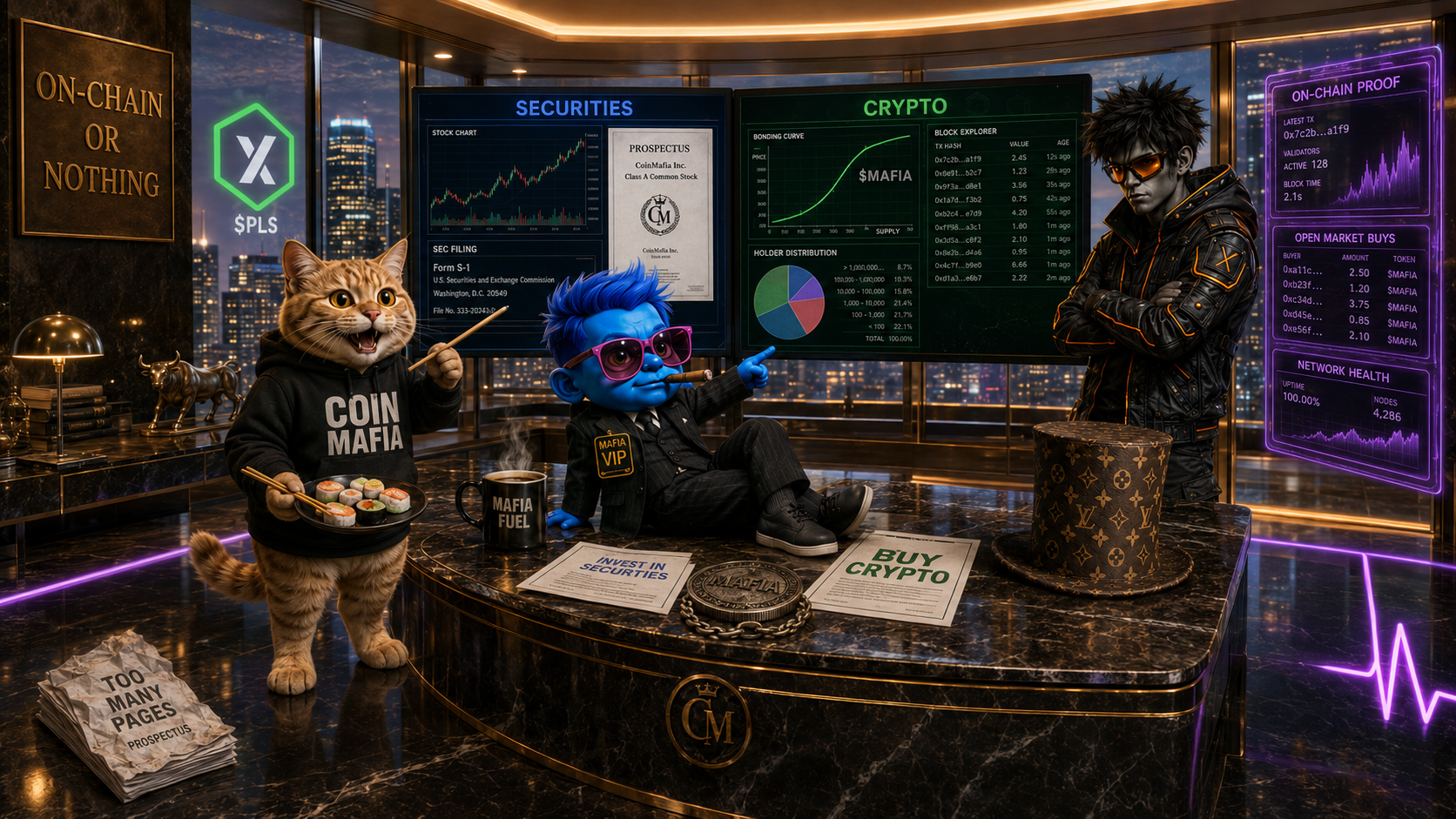
  • The Difference Between Buying Crypto and Investing in Securities and Why It Matters

    The Difference Between Buying Crypto and Investing in Securities and Why It Matters

    This is not a legal opinion. It is not financial advice. It is a distinction that most people entering crypto from a traditional finance background get wrong, and getting it wrong shapes how they evaluate everything else in the space.

    The difference between buying crypto and investing in securities is not just semantic. It is structural, regulatory, and practical. Understanding it changes how you think about due diligence, how you think about risk, and how you think about what you are actually buying when you buy a token.

    What a Security Is

    A security, in the legal sense most people in the United States are familiar with, is an investment contract. The classic test for whether something is a security comes from a 1946 Supreme Court case involving orange groves. The test asks four questions. Is there an investment of money? Is it in a common enterprise? Is there an expectation of profit? Does that profit come primarily from the efforts of others?

    If the answer to all four is yes, the thing is likely a security. Securities are regulated by the SEC. They require registration or an exemption. The companies issuing them have specific disclosure obligations. Buyers have specific legal protections.

    Stocks are securities. Bonds are securities. Certain structured financial products are securities. When you buy these things, you are buying into a legal framework that governs how information is disclosed to you, how the company is allowed to raise money, and what recourse you have if something goes wrong.

    What Crypto Is

    Crypto is different, and the distinction matters most at the level of what you are actually buying.

    When you buy Bitcoin, you are buying a digital asset. There is no company behind it issuing shares. There is no expectation of profit from someone else’s management decisions. You are buying a token that exists on a decentralized network and derives its value from the network itself, from supply and demand, and from the utility the network provides.

    When you buy a token on a bonding curve launchpad, you are buying a token. The price is set mathematically by the curve, not by a valuation assigned by a company raising capital. There is no team giving you equity. There is no promise of dividends. There is no prospectus.

    This does not mean crypto has no regulation. It means the regulatory framework is different, still developing, and the distinctions between what is and is not a security in the crypto context are actively being litigated and legislated.

    Why Professionals Get This Wrong

    Most professionals who come to crypto from traditional finance apply a securities analysis framework to everything they see. They look for disclosures. They look for audited financials. They look for regulatory clarity. When those things are absent, they conclude the asset is too risky or too speculative to touch.

    That analysis is not wrong. It is just incomplete because it is looking for the wrong things.

    Crypto does not offer audited financials. It offers on-chain transaction records that are more transparent than any financial statement because they cannot be revised after the fact. It does not offer SEC disclosures. It offers public contracts that anyone can read. It does not offer regulatory clarity in the traditional sense. It offers mathematical mechanisms that operate the same way regardless of what any regulator says about them.

    The due diligence for crypto is different from the due diligence for securities. Neither is superior. They are designed for different things.

    The Practical Difference When You Are Buying

    When you buy a stock, you are trusting a legal and regulatory framework to protect you. When you buy crypto, you are trusting math, code, and on-chain mechanics to protect you.

    This means the questions you ask are different. For a stock you ask about earnings, management, competitive position, and regulatory exposure. For crypto you ask about the contract, the liquidity structure, the token distribution, and what infrastructure exists underneath the token beyond the narrative around it.

    Both sets of questions are legitimate. They are just pointed at different things because you are evaluating different types of assets.

    Where CoinMafia Sits in This Framework

    $MAFIA is a token, not a security. It launched on PulseChain through a bonding curve. The price is determined by supply and demand mechanics built into the curve, not by a company valuation or a fundraising round. There is no hidden team allocation that resembles equity. There is no promise of returns from the efforts of others.

    What there is: a public contract, verifiable on-chain. A bonding curve that makes the launch mathematically fair. Validator infrastructure that generates real revenue and uses that revenue to buy $MAFIA from the open market continuously. Permanent burn mechanisms that reduce circulating supply over time.

    These are the things worth verifying before you buy. Not because they function like securities protections but because they are the crypto-native equivalent: transparent, on-chain, and readable by anyone willing to look.

    The professionals who navigate crypto well are the ones who learn to ask the right questions for this asset class rather than importing questions designed for a different one. The framework exists. It just looks different from what most people trained in traditional finance are used to.

  • What Are PulseChain Validators and Why They Matter

    What Are PulseChain Validators and Why They Matter

    If you have spent any time in the PulseChain ecosystem you have seen the word validator. It comes up in conversations about network security, about staking, about why certain projects are more trustworthy than others. Most explanations of what a validator actually is assume you already understand blockchain infrastructure.

    This one does not.

    What a Validator Does

    A blockchain is a public record of every transaction that has ever happened on that network. For that record to be trustworthy, someone has to verify that each new transaction is legitimate before it gets added. That is what validators do.

    On PulseChain, validators are the computers and the people operating them that confirm new transactions, add them to the blockchain, and keep the network running. Every time someone buys a token, sends funds, or interacts with a smart contract on PulseChain, validators are the infrastructure that makes that transaction real and permanent.

    Without validators, the network does not function. With validators operating honestly and consistently, the network is secure and the record is trustworthy.

    How Validators Get Chosen and How They Get Paid

    PulseChain uses proof-of-stake consensus. This means validators are selected to confirm transactions based on the amount of $PLS they have staked, meaning locked up as collateral. Staking $PLS signals that a validator has skin in the game. If a validator behaves dishonestly, their staked $PLS can be reduced as a penalty.

    In return for validating transactions honestly, validators earn rewards. These rewards come from the network itself in the form of newly issued $PLS and from transaction fees paid by users. The more consistently a validator operates and the more transactions it processes, the more it earns.

    This is the mechanism that ties validator activity directly to network health. Validators are incentivized to keep the network running cleanly because their earnings depend on it.

    Why Most Projects Do Not Run Their Own Validators

    Running validators requires real infrastructure. It requires hardware, a stable data connection, technical maintenance, and capital to stake. Most crypto projects do not do this. They rely on the public validator set that already exists on whatever chain they build on.

    This is not necessarily a problem. The public validator set on PulseChain is large and functional. But it means those projects have no direct relationship with the infrastructure that secures their network. They are users of it, not participants in it.

    What CoinMafia Built and Why It Matters

    CoinMafia committed over $600,000 to build and operate its own validator infrastructure on PulseChain. This includes hardware, equipment, and a dedicated data center. CoinMafia currently operates 2,000 validators with plans to scale to 4,000 and potentially 7,500.

    This is not a marketing claim. Validator activity is publicly visible on-chain. Anyone can verify that CoinMafia validators are running, how many blocks they have validated, and what their performance record looks like. The on-chain record is the proof.

    The reason this matters for $MAFIA buyers is the mechanism it creates. Every dollar of profit generated by CoinMafia’s validator operations goes directly to open-market buys of $MAFIA around the clock every day of the year. This is not a promise or a roadmap item. It is a live operational mechanism with a verifiable transaction history.

    When validator fees generate profit, that profit buys $MAFIA from the open market. Those transactions are posted publicly with their transaction hashes so anyone can confirm they happened on the timeline they were claimed. The buying pressure is real. The mechanism is on-chain. The receipts exist.

    Why Validator Scale Changes the Math

    The difference between 2,000 validators and 7,500 validators is not just a larger number. It is a fundamentally different level of fee generation and therefore a fundamentally different level of open-market buying pressure on $MAFIA.

    At 2,000 validators, the mechanism is operational and producing results. At 7,500 validators, the same mechanism produces proportionally more validator fee revenue, which produces proportionally more open-market $MAFIA buys, which produces proportionally more consistent buy pressure on the coin regardless of what the broader market is doing.

    This is what validator-backed infrastructure means in practice. Not a buzzword. A mechanism that scales.

    What This Means for Anyone Buying $MAFIA

    The validator operation creates something most meme coins do not have: a revenue source that funds buying pressure independent of new buyers entering the market. Most tokens depend entirely on new buyers to sustain price. When new buyers stop arriving, there is nothing holding the floor.

    $MAFIA has validator fee revenue going to open-market buys continuously. That is a structural difference, not a narrative difference. It is verifiable on-chain by anyone who wants to look.

    If you want to verify it yourself, the process is the same as any on-chain verification. Find the CoinMafia validator addresses through their official documentation. Pull them up on the PulseChain block explorer at scan.pulsechain.com. Look at the transaction history. The buys are there.

    That is what on-chain proof looks like when a project has nothing to hide.